Kuwait is quietly reversing one of the Gulf War’s longest-running scars: since 2021 a microbial soil rehabilitation project at the Burgan field has been treating vast tracts of oil-contaminated ground left by the 1991 fires.
Khaled A. Al-Haid, who was 13 during the fires, said he remembers being “terrified to see an ocean of crude everywhere.” He recalled asking a relative, “I asked my uncle: ‘You can pump out the oil, but what do you do with the soil?’”
The scale of what Al-Haid lived through is still stark on paper. Retreating Iraqi forces torched nearly 650 Kuwaiti oil wells in 1991, and an international coalition of 16,000 firefighters labored for nearly nine months until the last well was capped on Nov 6, 1991. Hundreds of toxic oil lakes and polluted desert remained; the Kuwait Oil Company said a third of Kuwait’s territory was polluted. “For nearly 10 months, everything in Kuwait was turned upside down,” Mohammad Mubarak Al-Qahtani said. “Daylight was obscured by thick smoke, and nights were lit up by the distant glow of burning oil wells. A third of Kuwait’s territory was polluted, and its ecosystem was devastated. Birds avoided Kuwait entirely, migrating elsewhere. Pollutants even drifted as far as the Himalayas.”
That destruction is the context for the work now underway at Burgan, the world’s second-largest oilfield. Kuwait decided in late 2019 to seek a global solution to the contaminated soil problem, and in 2021 Hangzhou Zaopin ST Co Ltd won the bid to carry out rehabilitation. Since then, Zaopin says it has already treated over 5 million tons of contaminated soil in Kuwait using microbial methods it developed from local samples.
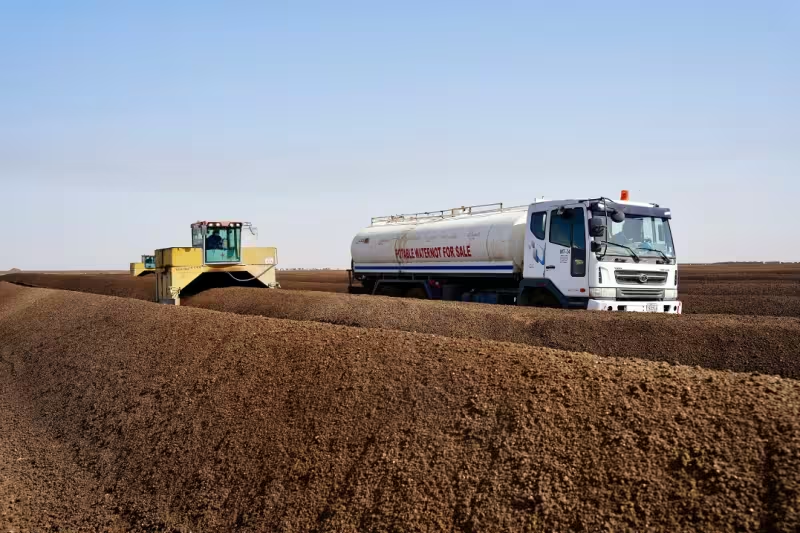
The operation is mechanical and biological. Specialized vehicles churn the black, oily earth while sprinklers apply water laced with petroleum-degrading bacteria. At one operation site nearly 470,000 metric tons of contaminated black soil are spread across a treatment area. Zaopin said it identified and cultivated microbes from more than 2,000 bacterial strains collected from Kuwait’s oil sludge. The company reports that in a three-month treatment cycle oil content in the soil falls from about 5 percent to below 1 percent, and the treated soil then meets Kuwait’s environmental standards. “We came to Kuwait with confidence — not in our brand, but in our expertise,” Dai Baiping said. “It was our first major international project, and it felt like the moment our technology had been waiting for.” He added, “We succeeded in identifying and cultivating microbes from more than 2,000 bacterial strains collected from Kuwait’s oil sludge.”
The numbers show progress, but they also underline the challenge. Treating more than 5 million tons is a major achievement. Yet the presence of single sites holding nearly half a million tons of contaminated soil demonstrates why the cleanup remains an extended undertaking. The original fires left hundreds of toxic lakes and a pollution footprint that the Kuwait Oil Company described as amounting to a third of the country’s territory — a scale that no single method can erase overnight.
The friction runs deeper than logistics. Memories like Al-Haid’s keep the human stakes in focus: the physical blasting of wells in 1991 created visible flames and smoke, but the invisible, long-lived pollution of soil has been the question people have asked ever since. The rehabilitation method addresses that precise problem by removing oil content from soil so it meets established standards, turning a once-intractable residue into material that can be returned to the land.
For Kuwait, the measurable drops in soil oil content and the volume already processed mean the country is no longer simply trying to contain a legacy; it is undoing it in places. The program’s reported successes — from microbial strains gathered locally to treatment cycles that reduce oil concentration to regulatory thresholds — show a working solution at scale. For Al-Haid, who once asked what to do with the poisoned earth, the answer is arriving in the form of churned soil, sprayed bacteria and treated land that now meets the country's standards. The remediation does not erase the memory of the fires, but it does provide the practical fix his childhood question demanded.