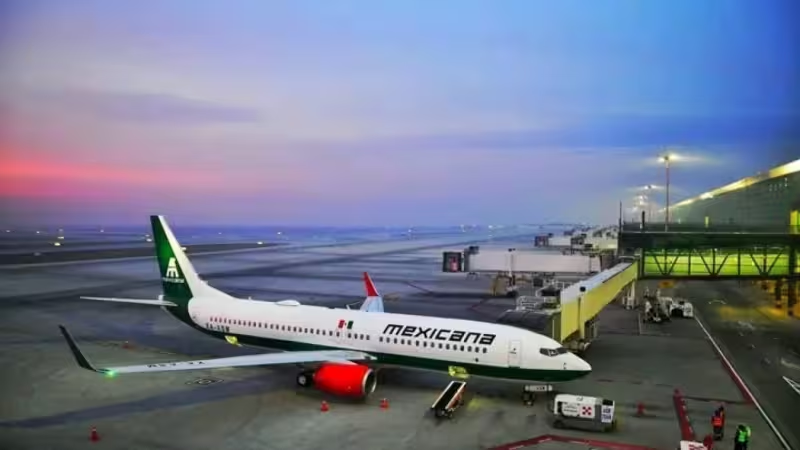
Grupo Financiero Monex projects passenger traffic in Mexico will rise between 4% and 6% during the 2026 FIFA World Cup, a surge the bank says could translate into US$1.8 billion to US$3 billion in economic impact nationwide over the tournament period.
Monex’s numbers come with hard, specific expectations: the tournament runs from June 11 to July 19 across North America, Mexico will host 13 games in Mexico City, Guadalajara and Monterrey, and tourism authorities estimate about 5.5 million additional visitors — a 44% jump in tourism activity during the competition window. Officials also estimate the World Cup could create roughly 24,000 direct jobs across hospitality, transportation and related sectors.
The report drills down by airport operator. Monex forecast passenger traffic growth in 2026 of 3.9% for Grupo Aeroportuario del Sureste (ASUR), 2.3% for Grupo Aeroportuario del Pacífico (GAP) and 7.3% for Grupo Aeroportuario del Centro Norte (OMA). Analysts also estimated average tourism growth of between 4% and 5% across airport groups during the tournament cycle.
Monex framed the event as both an immediate demand shock and a structural gain for Mexican aviation. The bank said the World Cup will be a key driver of aviation and tourism growth through 2026 and into 2027, and it forecast a compound annual growth rate of approximately 4.5% for Mexico’s airport sector between 2026 and 2029, projecting passenger traffic across the system could increase by as much as 25% by 2029.



Brian Rodríguez Ontiveros, who has worked on aviation and tourism forecasting, warned that Mexico’s lift will be real but not as large as in some previous tournaments: "What we have seen historically is that in Russia in 2018 and Qatar in 2022, growth ranged between 8% and 15%, depending on the timing of the tournament" and "In Mexico, the effect will be lower because the United States is the main host." Rodríguez Ontiveros’s comments underline a central tension in the Monex case: strong localized demand in Mexican host cities, but a smaller share of tournament traffic because the United States carries the bulk of matches and visiting fans.
That tension shows in operational detail. Airlines have increased seat availability at Mexico City International Airport after recovering aircraft previously affected by maintenance and supply chain delays, a move that supports the Monex forecast but also signals competition for capacity and fares among carriers serving connecting traffic from across North America.
For Mexico’s airport operators, the World Cup could be both a short-term revenue spike and a platform to capture longer-term travelers who connect through or return after the tournament. Monex’s scenario lays out a path where immediate gains during June and July 2026 feed higher baseline traffic into 2027 and then compound through 2029, lifting systemwide passenger volumes and justifying investments in capacity and services.
The clearest conclusion is that the 2026 World Cup will be a genuine accelerator for Mexico’s aviation and tourism sectors, delivering measurable economic and employment benefits while leaving the largest share of headline growth to the U.S. host cities; Mexican airports and service providers will see solid—but not runaway—gains that are likely to be unevenly distributed by city and operator.