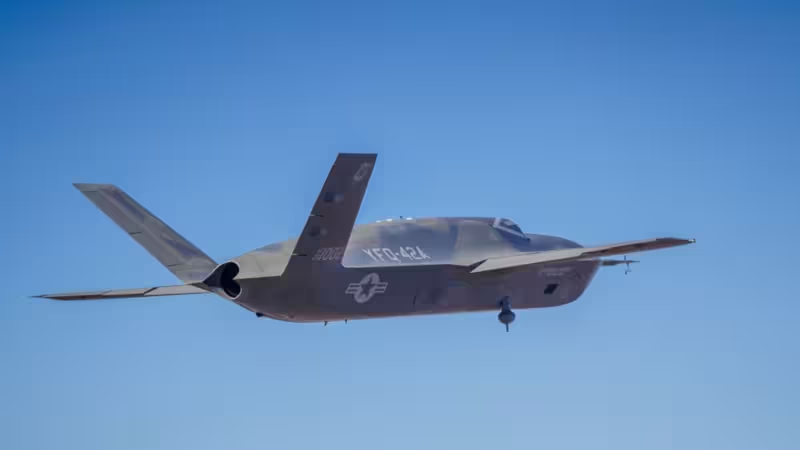
GE Aerospace was awarded a U.S. Air Force contract on May 19 to advance its GE426 engine into the preliminary design review phase for the service’s Autonomous Collaborative Platform program.
Steve “Doogie” Russell, a lead voice at GE Aerospace, framed the award as a step in a push to translate rapid small-engine development into production-ready propulsion: "We’ve proven we can rapidly move from concept to engine demonstration with the GEK800, and our focus now is on applying that process to the GE426 to ensure it provides the performance, affordability, and readiness the warfighter needs."
The market reaction has been noticeable: GE’s stock was reported at $302.84, with gains of 7.6% over the past week, 9.6% over the past month and 30.8% over the past year, even as the share price sits 5.6% below its level year to date. Longer-term returns remain striking — the stock has risen 275.5% over three years and 342.9% over five years — figures investors will weigh against the program’s defense implications.
The contract moves the GE426 program into preliminary design review and focuses on propulsion for medium-thrust autonomous combat aircraft, a class of platforms the Air Force is developing to support piloted fighters in combat, intelligence gathering, surveillance and electronic warfare. GE Aerospace said the GE426 was designed to balance performance, affordability and manufacturability and to meet military standards for performance, cost and scalable production.
GE Aerospace completed the GE426’s concept design review in August 2025, and the new award continues design and development work under the Autonomous Collaborative Platform effort. Company officials stressed the award builds on prior work: GE has already partnered with Kratos Defense & Security Solutions on the GEK800 and GEK1500 propulsion systems and highlighted that experience as central to moving quickly from concept to demonstration.
Still, public details remain sparse. GE Aerospace has not disclosed the contract’s dollar value or the GE426’s precise thrust rating, facts that leave a critical gap between what the company says it will deliver and what analysts and the Air Force will need to evaluate program cost and industrial-scale production. The Air Force program’s goal of fielding fleets of autonomous platforms makes questions about scalable manufacturing and unit costs more than technical footnotes.
The tension is simple: GE says the GE426 is being developed for medium-thrust autonomous missions and for scalable production, and company leaders point to rapid prior development cycles as evidence it can deliver. But without the contract value or thrust figures, independent assessment of affordability and production pace is limited — and those are the metrics that will determine whether the program can meet the Air Force’s ambitions at fleet scale.
This award, and the move into preliminary design review, is the clearest sign yet that GE Aerospace is converting a string of fast-turnaround small-engine projects into a defense-facing production effort. For investors watching ge stock, the question is no longer whether GE can design next-generation propulsion; it is whether the company can turn those designs into affordable, scalable production that supports a new class of autonomous aircraft and justifies the rising valuation.