Arvind Krishna on May 21, 2026 announced that IBM and the U.S. Department of Commerce had signed a Letter of Intent to establish Anderon, which the companies described as America’s first pure‑play quantum chip foundry.
The deal backs Anderon with a proposed $1 billion in CHIPS incentives from the Commerce Department and $1 billion in cash from IBM, and places the new company in Albany, New York as a standalone 300mm quantum wafer fabrication facility focused initially on superconducting qubit and supporting electronics wafers.
The size of the wider package underlined why the announcement mattered: the Commerce Department said the quantum program totals $2 billion spread across nine companies. GlobalFoundries is set to receive $375 million; D‑Wave Quantum, Rigetti Computing, Infleqtion, Atom Computing, PsiQuantum, and Quantinuum are each set to receive $100 million; and Diraq is set to receive $38 million.
Krishna underlined IBM’s role in the push. "IBM has pioneered quantum computing for decades," he said, and added that, "Our work in silicon wafer fabrication has been a key to IBM’s success and will be critical to enable a broader quantum technology landscape that will reshape global innovation and economic competitiveness." He told reporters the new business could generate billions of dollars a year in sales with high profit margins by the mid‑2030s.
Commerce Secretary Howard Lutnick framed the move as industrial policy. "strategic quantum technology investments will build on our domestic industry, creating thousands of high‑paying American jobs while advancing American quantum capabilities," he said, pointing to the job and manufacturing angles of a domestic foundry network.
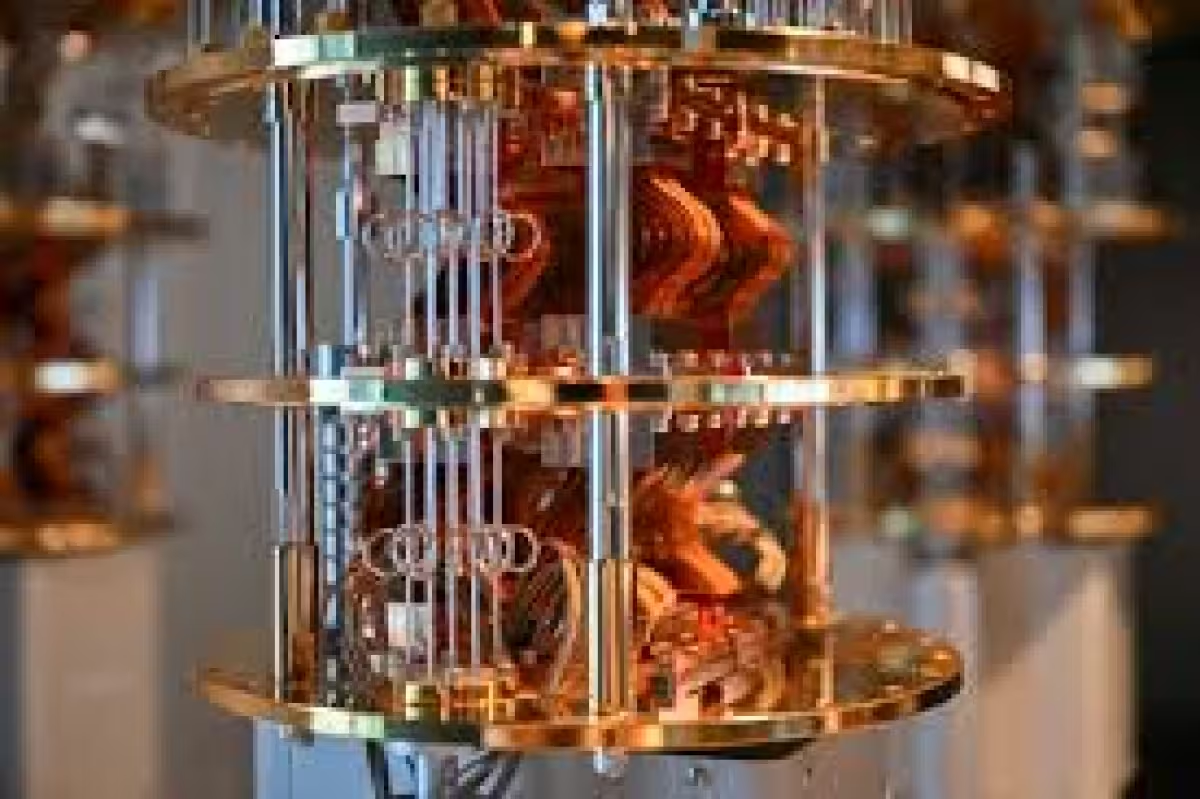
Context: Anderon is being pitched as a 300mm superconducting quantum foundry built around IBM’s manufacturing capabilities. The Commerce Department’s package covers companies working across trapped ion, photonic, neutral atom and superconducting approaches, and the government will take minority equity stakes in each of the nine companies — a deal structure the department has applied before to Intel, Vulcan Elements and MP Materials.
The announcement resolves one immediate question — where a large, U.S.‑based quantum foundry might land — but raises others that will matter to markets and to companies building hardware. The facility will initially support superconducting qubits and related electronics, and officials said Anderon plans to expand into other quantum modalities. That staged approach opens a timing gap between public investment and the broader commercial availability of wafers for non‑superconducting technologies.
There is a friction point between public ownership and private capital. By taking minority equity stakes, the government binds its own return and policy goals to the success of these startups. That reduces some risk for private developers but alters corporate governance and exit dynamics. The Commerce Department has used this model in recent industrial initiatives; whether it speeds adoption or complicates follow‑on financing will be a central test for the program.
Investors will watch the mechanics closely. Public and private financiers will want to know how the Commerce incentives will flow, what access non‑IBM firms will have to a 300mm foundry built around IBM processes, and whether the government stakes limit or accelerate outside investment. Traders tracking qbts stock and other publicly traded quantum plays will read those details as signals about the state's appetite for long‑term ownership and the likely pace of commercialization.
This is, plainly, a government‑backed bet that domestic fabrication matters. If Anderon can scale a 300mm process beyond superconducting devices and if companies can translate prototype devices into high‑margin products, Krishna’s mid‑2030s revenue forecast becomes plausible. If the foundry remains narrowly focused or political constraints limit partners’ access, the broader quantum ecosystem could face a slower, more fragmented rollout. The single actionable question left by May 21 is whether the structure that pairs CHIPS money with minority equity will accelerate a working supply chain or simply redistribute early commercial control — and the answer will shape who benefits from the next decade of quantum hardware development.