AST SpaceMobile won Federal Communications Commission approval on April 21, 2026 to modify its license and deploy a 248-satellite non‑geostationary constellation and to provide supplemental low‑band coverage from space using partner operators’ 700/800 MHz spectrum.
The approval cleared the regulatory hurdle that has long shadowed the company’s bid to link regular smartphones to its BlueBird satellites, and the market reacted: asts stock rose about 8 percent in morning trading on the approval date and closed at $105.86 per share on May 22, 2026.
The FCC order sets firm deadlines that now define the company’s path: at least 50 percent of the 248 satellites must be launched by August 2, 2030, and the remainder must be operational by August 2, 2033. Regulators also required coordination with the National Science Foundation and international bodies to avoid radio interference.
Investors and analysts pointed to recent operational signals to explain the rally. Crossroads Capital said: "AST SpaceMobile, Inc. (NASDAQ:ASTS): Q1 picked up exactly where Q4 left off." The firm added that AST’s shift from research and development to large‑scale operations had "went from “underway” to “unmistakable”" over the last three months, citing the company’s Q1 2026 revenue of $14.7 million, full‑year 2025 revenue of $70.9 million and management guidance for 2026 revenue of $150 million to $200 million.
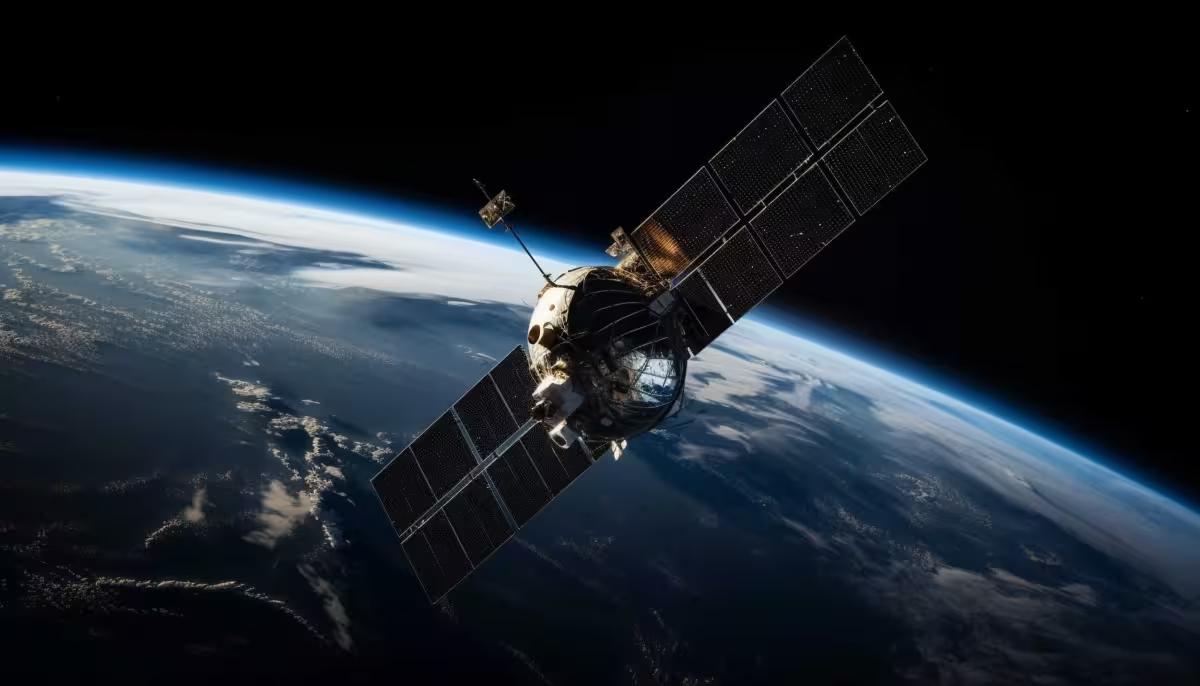
Crossroads flagged other financials bolstering the case for scaleup: a contracted backlog of $1.2 billion, $3.5 billion in cash reserves as of Q1 2026 and a $191 million net loss in the same quarter. The advisory also noted plans to place 45 to 60 operational spacecraft into orbit during 2026 and said "management noted revenue will be heavily weighted toward the second half of the year as launches begin and commercial service activates…"
That mix of cash, backlog and near‑term launch plans underpins the bullish thesis, but the approval shifts the company’s principal risk from licensing to execution. The FCC granted permission to use partner carriers’ low‑band spectrum, and the supplementary reporting of the approval followed a five‑and‑a‑half‑year licensing process and the firm’s partnership‑based spectrum access through Verizon, AT&T and FirstNet.
Tension remains inside that narrower field. Crossroads Capital blamed a recent operational stumble on a third party, saying BB7 was placed in the wrong orbit by the New Glenn 3 rocket and that the episode "sparked a downturn that had everything to do with Blue Origin’s vehicle misplacement, not any failure of AST’s technology." The company must still manufacture and launch up to 248 satellites, integrate those spacecraft with partner spectrum, and co‑ordinate internationally to prevent harmful interference — all while meeting the FCC’s staggered deadlines.
Those deadlines are the clearest next test. AST must get roughly half of the constellation into orbit by August 2, 2030 and have the whole system operational by August 2, 2033. If the company executes the launch cadence it has outlined — 45 to 60 operational spacecraft this year and continued deployments afterward — the regulatory approval will have removed the chief barrier to commercial service. If it fails, investors who pushed asts stock higher on the clearance will quickly reprice the company around execution shortfalls, not licensing risk.
The single practical conclusion is this: with the FCC signoff, AST SpaceMobile’s challenge is no longer permission but delivery. The firm has cash, backlog and guidance that make a successful scaleup plausible; meeting the August 2030 milestone will be the decisive moment when permission turns into paying customers or into another test of whether a space‑based cellular network can be built at commercial scale.