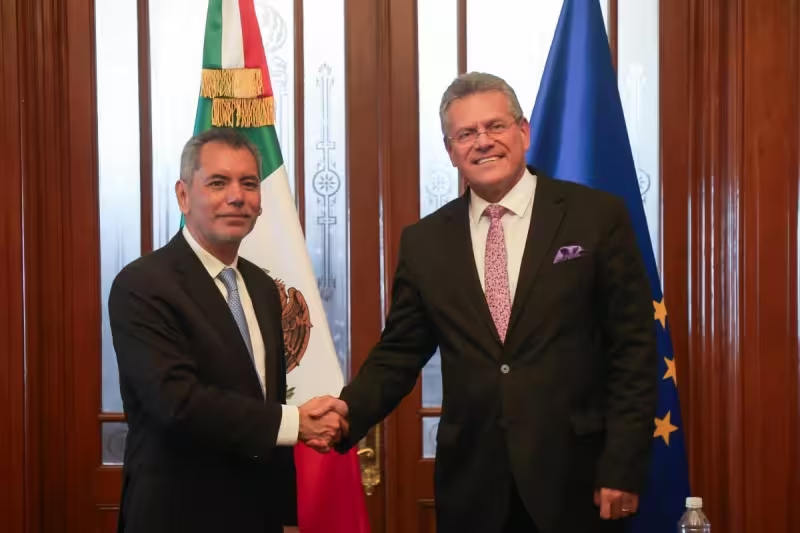
Ursula von der Leyen stood in Mexico City on Friday as the European Union and Mexico signed a revised trade agreement that replaces the 2000 deal and opens new market access for agricultural and industrial goods.
The pact, signed on 22 May 2026 at a summit attended by von der Leyen and António Costa, follows the completion of negotiations in January 2025 and carries immediate tariff changes: the EU will remove duties on key European agricultural exports including pork, dairy products, cereals, fruit and pasta, while the EU will lower tariffs on Mexican coffee, fruit, chocolate and agave syrup. The agreement also protects 336 additional traditional food products.
Bringing numbers into the room underscored what is at stake. The EU already exports goods worth 53 billion euros and services worth 20.3 billion euros to Mexico, and the European Commission singled out the agrifood sector as “one of the biggest winners” from the modernized deal. The Commission said its investment plan under the Global Gateway will back projects linked to the energy transition, transport, pharmaceuticals and health, water, agriculture and digital transformation tied to the pact.
That list of sectors — and the scope of new rules on access to raw materials, public procurement and intellectual property protection included in the modernized agreement — show the deal is meant to be more than tariff trimming. It is a deeper economic partnership that officials say will knit the two economies closer at a strategic moment for global trade.
Still, the signing arrived only after more than a year of delay following the close of talks. EU officials said the holdup was procedural: an EU representative told delegations the signing delays were due to translation and legal review work. The pause left time for regional dynamics to shift; one European leader, Kaja Kallas, had said on the eve of the summit that “Es wird unser erster Gipfel seit mehr als einem Jahrzehnt sein, und in einer Zeit, in der die internationale Ordnung schwer ins Wanken geraten ist, geht es hier um mehr als nur Handel. Es ist ein geopolitisches Statement.”
Context matters. The original EU–Mexico agreement entered into force in 2000; the new accord replaces that framework with updated rules designed for supply chains and investment patterns of the 2020s. Mexico remains closely tied to the United States — around 80% of Mexican exports go to the United States — and the EU is Mexico’s third-largest partner. Mexico is nonetheless one of the EU’s most important trading partners in Latin America alongside Brazil, and the new deal is likely to be read alongside efforts by Canada and Mexico to modernize their North American pact, USMCA.
The bargain rewrites practical terms as well as symbolism. It removes tariffs on a swath of European farm goods while granting tariff cuts and protections to Mexican specialties; it enshrines protections for 336 traditional food products and creates new rules that cover raw materials, public procurement and intellectual property — elements the supplementary documents said were absent or outdated in the 2000 agreement.
The tension in the room was plain: the EU framed the signing as a renewal of ties and a strategic investment in supply chains, while the procedural excuse for the long delay — translation and legal review — underscored how technical hurdles can reshape political timing. For Mexico, the deal offers clearer access to European markets and EU investment through Global Gateway projects, but it does not change the blunt fact that the United States remains Mexico’s dominant export destination.
In practical terms, European agrifood exporters will see immediate tariff relief and Mexican producers will gain broader protections and lower duties on selected goods; the deal also opens the door for EU-backed investments across energy, transport, health and digital projects. The likely result is faster commercial integration with Europe, but not an instant redirection of Mexico’s trade flows away from the United States — a sober outcome supported by the 80% figure for Mexican exports to the US.