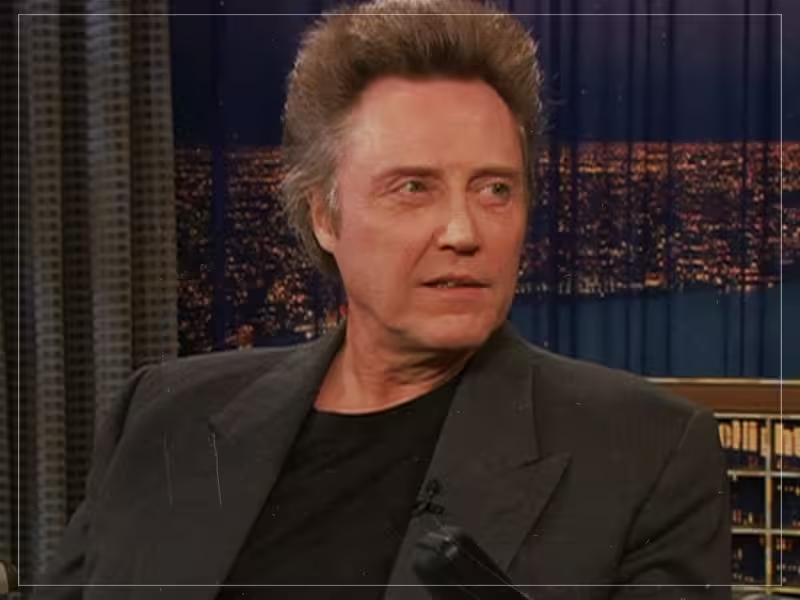
Christopher Walken pushed back against the film’s obscurity, calling the 1988 musical fantasy Puss in Boots a solid piece of work and one of his stronger turns on screen.
“I did another musical movie of the kids’ story, Puss in Boots,” Walken said, then added, “Which nobody ever saw, but it’s good.” He doubled down on the appraisal elsewhere in the same exchange: “It’s actually one of my best performances, I think,” and later, “Nobody’s seen it, but it’s really one of my better ones.”
The movie was released in 1988 and, as Walken noted, never received a United States theatrical release; it was quietly shuffled out on home video and television. In the 20+ years since, the film has surfaced mostly as an oddity — a curiosity for viewers who seek out forgotten experiments or films that bloom into cult appreciation on the back of their strangeness.
Those comments carry extra weight because of who is making them. Walken is an Academy Award winner with hundreds of credits to his name. Even within that vast résumé, he chose to single out a long-obscure, off-the-wall Walken-starrer. For christopher walken, the defense fits a pattern: he has defended other maligned projects, including Gigli, and he has not shied from saying he values work that mainstream audiences and distributors overlooked.

The context tightens the contradiction. Puss in Boots is described as a musical fantasy in which Walken plays a cat who transforms into a man whenever he puts on the titular footwear — a premise that helps explain why it never found a wide audience and why distributors opted against a U.S. theatrical release. The film’s path — from a curious festival or foreign run to home video and television — left it vulnerable to the kind of afterlife that turns misfires into cult ephemera rather than into reassessed classics.
That friction is the story’s tension: the actor of stature insisting a lost, lightly circulated picture belongs near the top of his work, while the market and audiences treated it as disposable. Walken’s praise is not hypothetical; it is a direct, emphatic claim about artistic value coming from an artist with an Oscar and decades on the screen. At the same time, the practical facts remain: the film did not get the theatrical push that typically secures a place in wider memory, and much of its later attention has come from viewers who celebrate cinematic oddities rather than conventional excellence.
The practical consequence is straightforward. Walken’s defense is unlikely to conjure a new wide release or radically alter the film’s fortunes in the short term. But it does change how the film sits inside his career. When an Academy Award winner with hundreds of credits says, “Nobody’s seen it, but it’s really one of my better ones,” that claim reframes Puss in Boots from a forgotten footnote to an item of personal importance in a storied body of work.
That reframing is the most lasting result: the remark invites reappraisal and may steer curious viewers back to home video and television archives to judge the performance for themselves. It will not erase the years of obscurity, but it will ensure Puss in Boots is no longer simply an oddity relegated to discussions of mishandled distribution — it is now a defended performance in the canon of an unlikely but rigorous actor.