



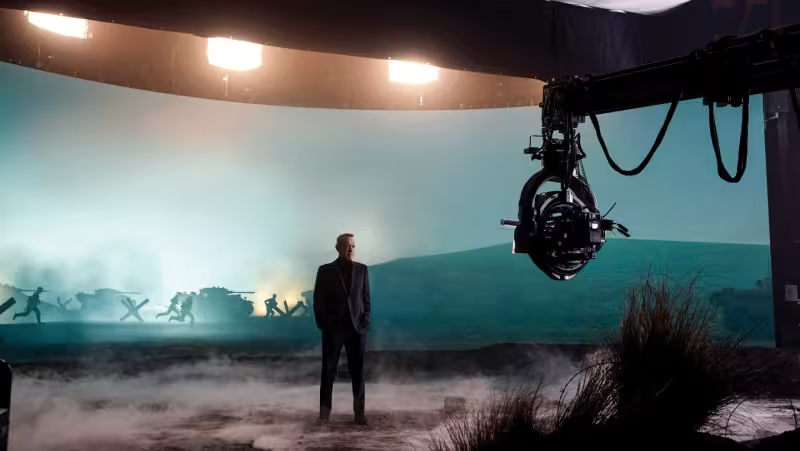
Tom Hanks is presenting a new 20-part History Channel docuseries, World War II With Tom Hanks, that will debut on Memorial Day and trace the conflict from the Nazi invasion of Poland in September 1939 through the Japanese surrender in September 1945.
The scale is part of the point: 20 parts that aim to cover every major theater of World War II, a scope the producers say has not been attempted on television since 1974’s The World at War on ITV. The series is executive produced by Hanks and historian Jon Meacham and was created in collaboration with the National World War II Museum in New Orleans. Hanks calls World War II "the largest event in human history," and the project leans on that claim as it seeks to stitch battlefronts from Europe to the Pacific into a single narrative.
Hanks told interviewers his fascination with the war began when he was 10. He recalled that his father was in the Navy and "had his life put on hold for four and a half, five years," and that he read Studs Terkel’s The Good War not long after high school. Those personal threads run through the series, which opens with the Nazi invasion of Poland in September 1939 and closes with Japan’s surrender in September 1945. Meacham, who co-produces the series, has offered a throwaway line that underlines the show’s mix of scholarship and personality: "Dork Wikipedia."
The History Channel project was assembled quickly by television standards. Hanks and Meacham met through mutual friends Tim McGraw and Faith Hill right after President George H.W. Bush died, and they pushed to build a production that would be global in reach and museum-grade in sourcing. The National World War II Museum advised on the series, giving it access to archives and expertise that producers say will help the series justify claiming the most sweeping view in decades. The series is being promoted as the first to take such an all-encompassing, global perspective since that 1974 benchmark.


This timing matters. The series arrives during a period when commentators worry that the lessons of the war are being corroded by rising Holocaust denial and far-right politics, and when educators and historians argue for renewed public attention to the conflict’s causes and consequences. Hanks’ star power and the museum partnership give the program an institutional heft that its makers hope will push the conversation back toward history rather than polemic.
There is tension at the heart of the enterprise. A television series cannot be every book, and a 20-part run must make choices about what to foreground and what to compress. Hanks has acknowledged that perspective sits alongside other aims: "Geez, what would I have done in the same circumstances?" he asked during conversations about the project, a line that signals a human-angle approach as much as a strategic one. At one point he added with a grin, "I’m delighted to know an anecdote that he is not aware of," underscoring the producers’ appetite for discovering and airing lesser-known stories even as they map global strategy and diplomacy.
The immediate next step is the Memorial Day debut on the History Channel, when viewers will see the first episode and judge whether the series achieves its promised breadth. The series’ arc—from the September 1939 invasion of Poland to the September 1945 surrender in Japan—means that viewers who stick with all 20 parts will watch the war unfold in full chronological sweep, something the producers say has not been done in this format since the 1974 series on ITV. The History Channel release page offers further scheduling and episode details (
Conclusion: by combining Hanks’ public profile, Meacham’s historicism, the National World War II Museum’s archives and a 20-episode canvas, World War II With Tom Hanks sets out to be the definitive television retelling of the conflict for a new generation; whether it succeeds will be decided by whether its narrative restores the war’s scale and lessons to the center of public memory rather than simply adding another celebrity-led account.


