



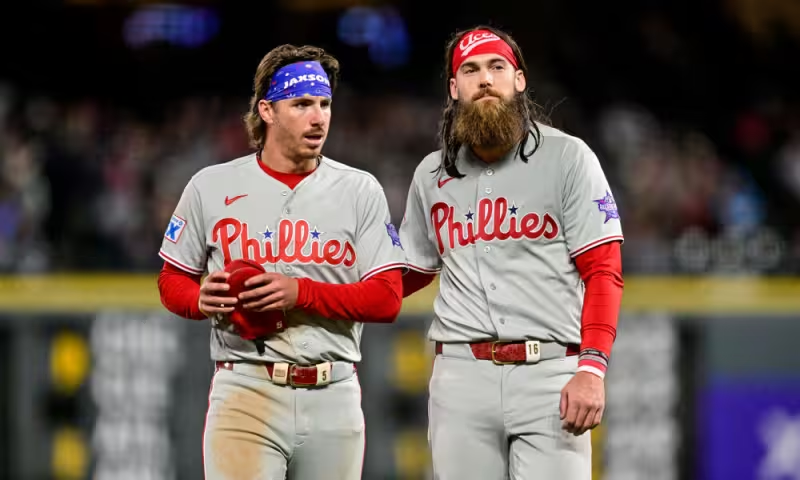
Brandon Marsh had 38 at-bats against left-handed pitching through May 24 — exactly half the total he recorded against lefties all of last season — as the Philadelphia Phillies have been forced to use him as an everyday player out of necessity.
The number stands out because it comes amid an uneven split between the club's left- and right-handed hitters. Bryson Stott, a lefty bat, went 2-for-2 on Sunday with two singles against left-handed starter Parker Messick and entered the day batting.346 with a.952 OPS in 26 at-bats vs. lefties. By contrast, J.T. Realmuto has a.423 OPS vs. lefties and Trea Turner a.601 OPS, figures that help explain why managers are hunting for any reliable production from left-handed hitters.
Don Mattingly, the Phillies' manager, pointed to the left-handers' success in Sunday’s matchup. "Our lefties actually, I felt like, handled (Messick) better than the righties today," he said. "Stotty had good at-bats, Schwarbs had good at-bats, Harp good at-bats, Marsh good at-bats." He added plainly, "Our righties just have to solve that problem."
The scoreboard of splits is stark. Entering Sunday the Phillies had the fifth-best OPS in the league from left-handed hitters against left-handed pitching at.749. The right-handed side, however, was last in the league, producing a.623 OPS; their righties were hitting a collective.202 with a.276 on-base percentage and a.609 OPS, down from much healthier rankings a year ago when right-handed hitters against lefties ranked ninth in batting average, 13th in on-base percentage and 14th in OPS.
Individual right-handed performances are a mixed bag. Alec Bohm carries a.792 OPS vs. lefties, Adolis García a.762 and Kyle Schwarber a robust.975, but Bryce Harper has managed only a.214 batting average and.687 OPS in 70 at-bats against left-handed pitching. Those uneven results have fed the team's reliance on Marsh, whose 38 at-bats vs. lefties through May 24 matched precisely half the 76 at-bats he faced all of last season. Marsh’s larger share of lefty exposure has come because the club’s planned solutions have yet to stick.
Justin Crawford, penciled in during the offseason as an everyday center fielder who could protect the lineup against left-handed starters, struggled in Triple-A, going 2-for-32 in a limited sample. Otto Kemp, touted as a potential platoon partner for Marsh in left field, returned from Triple-A Lehigh Valley and was hitless in five at-bats after his recall. On Sunday, Edmundo Sosa even started in left field, underscoring how the Phillies are juggling pieces to cover the matchup gap.
The small-sample swings in production complicate decision-making. Stott’s hot 26-at-bat run against lefties — he posted a.952 OPS in that span — follows seasons in which he was a liability against left-handers, with a.595 OPS in 2024 and a.575 OPS in 2025. Marsh himself produced a.576 OPS against left-handed pitching in 2025, which muddies the expectation that simply riding left-handed bats will solve the problem.
Trea Turner downplayed the weight of splits in the moment. "I guess that's the big statistic this year, but I don't really think about that," he said. "When you're up to bat, it feels like you're just competing. I think that's more of a coincidence than anything."
The tension is real: left-handed hitters have been doing their part, but inconsistent right-handed production and failed depth options have pushed Marsh into more frequent and riskier exposure to same-handed pitching. With Crawford and Kemp unable so far to provide the platoon relief the club envisioned, and with right-handed regulars offering erratic results, the Phillies are left to decide whether to keep leaning on Marsh's expanded role or to keep searching for a lineup fix.
For now the answer looks pragmatic: Marsh will keep seeing left-handed pitching. How long the team tolerates those matchups, and whether it will find a stable platoon partner or coax steadier results from its righties, will determine whether Marsh remains merely necessary or becomes the steady option the Phillies hoped to avoid.


