Colman Domingo said in a recent interview that he approaches fame carefully, prefers to keep the most personal parts of his life private rather than sharing everything on social media, and paid a heartfelt tribute to Chadwick Boseman as someone who still lifts others from beyond the public eye.
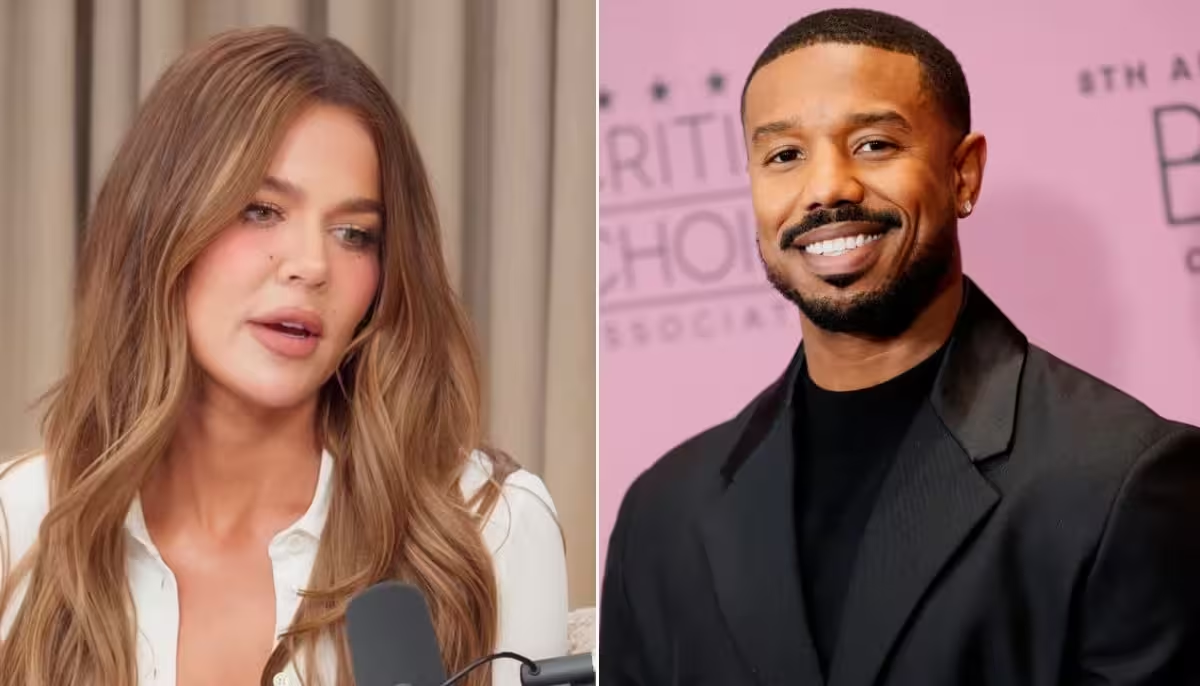
Domingo landed on the sharp point of the conversation with a line he repeated plainly: "I really feel like Chadwick Boseman has been lifting people like me and Michael B. Jordan up from the other side. I do believe I have a little, beautiful angel in my friend Chadwick." The sentence carried the weight of a close friendship and the kind of public grief that reshapes careers.
He made the same point about how he navigates attention. Domingo said he approaches fame carefully, especially online, and that he prefers privacy over constant exposure — a posture he contrasted with the expectation that artists must be perpetually visible to succeed.
That stance matters because Domingo did not arrive at this balance by accident. He originally studied journalism before discovering acting after moving to San Francisco. He built his reputation through theatre, reached Broadway and has worked with filmmakers whose names command attention, including Spike Lee and Barry Jenkins.
Those credits are the reason listeners care when Domingo talks about privacy: a career that runs from the intimacy of theatre to the exposure of Broadway and collaborations with major directors means the choices he makes about visibility affect how audiences and the industry see him.
But there is tension between the private life Domingo says he keeps and the public life his work requires. He plays parts on big stages and joins projects with filmmakers who put actors in spotlight roles. He pays tribute to a late friend in public forums. The contradiction is not hypocrisy so much as a practical squeeze: the more visible the work, the harder it is to keep the person beneath it unseen.
Domingo recognizes the squeeze and has chosen a particular response. He has said he prefers to keep the most personal parts of his life private rather than sharing everything on social media. That is not a retreat from influence — it is a method of control. By limiting what he makes public, Domingo is shaping how his career and his image expand.
He also used the interview to name a kind of spiritual support he feels from Boseman, tying personal loss to professional uplift. Domingo pointed to Boseman’s continuing influence on peers such as Michael B. Jordan and on himself, framing the late actor as an ongoing presence rather than a closed chapter.
That framing matters today because conversations about visibility, grief and who gets to tell which stories are shifting the entertainment industry’s center of gravity. Domingo’s path — from journalism student to San Francisco beginner, through theatre to Broadway, then onto screen collaborations with Spike Lee and Barry Jenkins — is a live example of how an artist can move between stages while choosing what to reveal.
The clearest answer to the question Domingo’s interview raises — will he step fully into the glare or keep a hand on the privacy dial? — is in his own words and record. He will keep working with high-profile directors and on Broadway, but he will continue to guard the private parts of his life and manage his online presence carefully. That choice makes him less a recluse than a technician of attention: present where his work must be seen, absent where his life should remain his own.