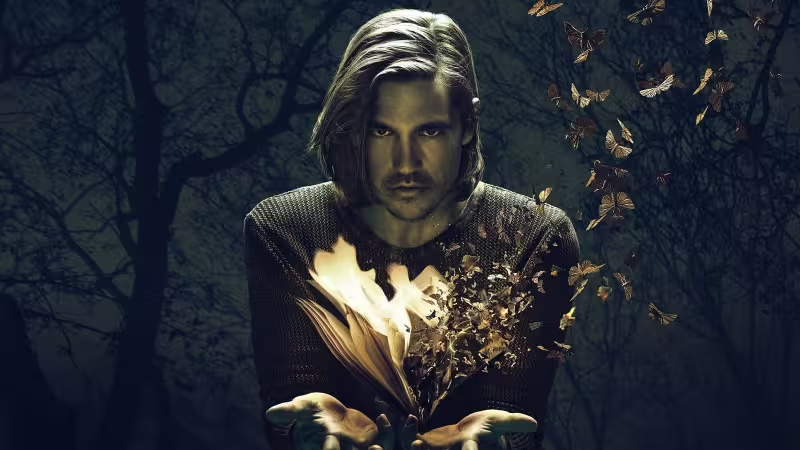
MovieWeb published a list of 10 high fantasy TV shows with great magic systems, and the examples it chooses make one point plain: rules matter. Nathan, the adolescent at the center of The Bastard Son & the Devil Himself, is the kind of character who only works because the show makes the stakes of magic clear.
The list runs through familiar names and striking mechanics. The Wheel of Time adapts a system built around the One Power, drawn from the True Source and split into feminine and masculine halves called Saidar and Saidin; channelers weave five different threads. The Witcher traces magic’s arrival to the Conjunction of the Spheres and treats Chaos as a primordial force, with the books drawing power from earth, water, fire, air and a fifth element called ether — and warning of real bodily risk to channeling that force. In the TV version, mages and sorcerers show an innate aptitude for tapping Chaos, while Sources occupy the top tier of power and can use it to the fullest.
MovieWeb also highlights how adaptations translate those systems for television. Netflix’s One Piece brings Devil Fruits — permanent powers granted to whoever eats them — to live action intact: the list notes that Luffy’s rubber-like body and the iron rule that Devil Fruit users cannot swim remain central, and that immersion in water carries significant consequences. His Dark Materials is represented by its daemons, physical manifestations of the self that take animal form and maintain a strong soul connection to their humans. Shahmaran, a Turkish show created for Netflix and based on a novel by Emine Buzkan Kaynak, ran for two seasons and centers on a woman who returns home to find her family in a cult that worships Şahmaran. The Bastard Son & the Devil Himself, adapted from a trilogy by Sally Green, received one season and follows Nathan as he discovers he is the illegitimate son of one of the magical world’s most dangerous witches. Lost Ollie appears on the list as a different breed: a stop-motion miniseries based on William Joyce’s children’s book about a lost toy that comes to life in a four-part story.



These examples matter because the list itself is a map of how television currently treats magic: as a device that must carry narrative weight, not only spectacle. MovieWeb’s selection frames One Piece as standing out among contemporary fantasy television for carrying the anime’s magic system into live action effectively. That framing places the onus on clarity — when a show defines its rules, the emotional and physical stakes follow.
There is tension built into that observation. The Wheel of Time adaptation, the list notes, “found its groove in its third season before its untimely cancellation,” a blunt reminder that a well-crafted system does not guarantee longevity on TV. Likewise, several entries are adaptations of novels or trilogies — His Dark Materials, The Wheel of Time, The Witcher, Shahmaran and The Bastard Son & the Devil Himself — and yet some of those adaptations run short lives on streaming platforms: one season for The Bastard Son, two seasons for Shahmaran. The Witcher’s books treat Chaos as physically dangerous; the TV series grants mages and Sources an innate facility that changes how risk reads on screen.
That contradiction is the real story MovieWeb’s list surfaces: television benefits when a fantasy world’s powers are precise, but precision alone won’t protect a show from cancellation or a shorthand adaptation that softens original risk. Successful fantasy television, the list implies, pairs internal logic — whether it’s five threads of the One Power or the permanent curse of a Devil Fruit — with storytelling choices that keep consequences visible and immediate.
So where does that leave the viewer? The takeaway is straightforward: the most memorable shows on MovieWeb’s list are those that treat magic as a rule-governed force that shapes character choices and danger. Nathan’s discovery of his parentage, Luffy’s inability to swim, a daemon’s single animal shape — these are not curiosities, they are the engines of drama. If a series preserves those engines, it can make magic feel consequential; if it strips them away, it risks leaving a spectacle with no weight.