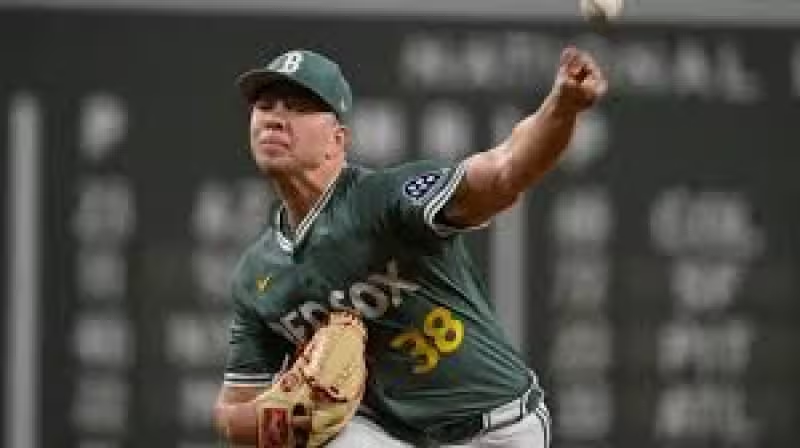
Kyle Harrison struck out 11 Chicago Cubs batters over seven innings in his ninth start Wednesday, lowering his season ERA to 1.77 and pushing his strikeout total to 59 for the year.
The left-hander, 24, now serves as the Milwaukee Brewers' No. 2 starter and has 41 of those 59 strikeouts in his last five starts, a run that has him at an 0.96 ERA across that span and averaging 11.9 strikeouts per nine innings.
The raw numbers have made the once-brief Red Sox experiment with Harrison — a 3.00 ERA in three games after Boston acquired him in the blockbuster Rafael Devers trade — look like a misstep to some observers now that the Brewers have him. Milwaukee, 29-15 and sitting atop the NL Central, received immediate value: Harrison has 59 strikeouts and is 1 1/3 innings short of being a qualified pitcher for ERA and award purposes.
Harrison's rise in Milwaukee has also sharpened scrutiny of the other side of that offseason swap. The Red Sox, 22-27 and fourth in the AL East, sent Harrison to the Brewers for Caleb Durbin, who came off a season in Milwaukee with a.721 OPS and 2.8 WAR. Critics on social platforms and in commentary have cast the trade as a clear win for Milwaukee; defenders of Boston point to Durbin's profile as a late-blooming bat and to the small sample Harrison produced in Boston and at Triple-A Worcester, where he had a 3.75 ERA in 12 starts.
The split in views is blunt. One analyst argued that Harrison’s current pace should put him in Cy Young consideration if maintained. Another noted mechanical tweaks over the offseason — a slight raise in arm angle, a move to the first-base side of the rubber and help from a peer on a new grip — as the technical reasons behind his spike in performance. At the same time, voices critical of Boston’s front office asked why a 24-year-old lefty, once a top-20 prospect in baseball and acquired from the San Francisco Giants in the Rafael Devers deal, would be traded for a utility-type bat instead of held as a potential rotation cornerstone.
The historical numbers complicate the narrative. Harrison showed promise but limited exposure in Boston, and his Triple-A numbers were unremarkable compared with what he is producing now: a 3.00 ERA in three games for the Red Sox and a 3.75 mark in 12 Triple-A starts before the trade to Milwaukee. With the Brewers, however, his last five starts alone account for 41 strikeouts, and his ERA has fallen to the fourth-best range among notable starters — a surge that helped keep Milwaukee competitive after offseason roster changes.
The tension is simple and decisive: Harrison is dominant but not yet fully qualified, and the verdict on the Harrison-for-Durbin swap hinges on durability and innings as much as dominance. Some commentators praise Milwaukee for unearthing a starter who can replicate ace-level results; others still argue Boston made a defensible move getting a bat in return for a pitcher who had not yet put together a long minor-league track record. The split opinions are mirrored in the metrics — elite strikeout totals and a sub-2.00 ERA versus a short season sample and the 1 1/3 innings that stand between Harrison and official qualification.
The single question now is plain: can Harrison sustain this level and log the remaining innings to qualify, turning a hot five-start run into a season-defining body of work that settles whether Milwaukee stole him and whether Boston miscalculated trading a young left-hander who had been a top prospect just a few years earlier?