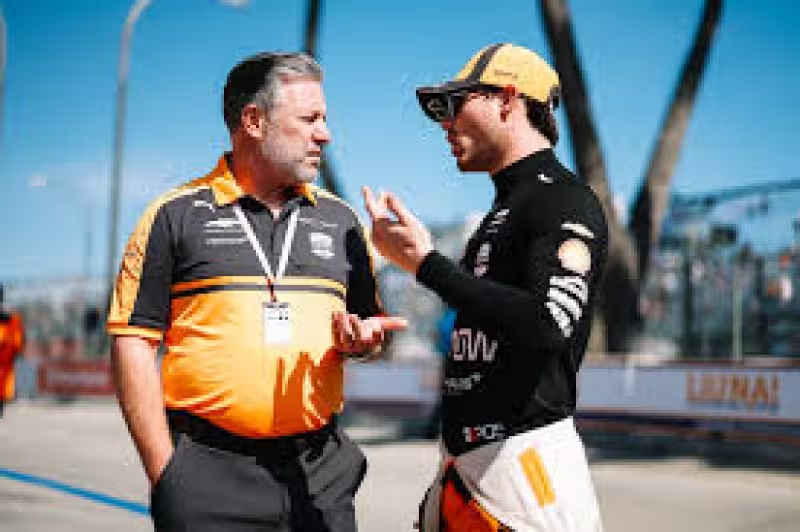
McLaren will start four cars in the 33-strong Indianapolis field on Sunday, and Pato O’Ward — going into his seventh Indy 500 — will be the most visible of the team’s charge to end a 50-year drought since Johnny Rutherford’s win in 1976.
That four-car entry is the clearest measure of McLaren’s renewed commitment to Indianapolis. O’Ward, 27, arrives off a 2025 season in which he won twice and finished second in the standings; he has failed to qualify in other years and has come within two corners of winning this race. “It’s all positive,” O’Ward said when asked about the pressure and the past. He added more fully that “It’s all been either a learning curve or some of the greatest memories that I have in my career.”
The numbers underline why McLaren’s presence matters. The team has not won the Indy 500 since 1976 — a half-century ago — yet it fields four of the 33 entrants this weekend. Ryan Hunter-Reay, 45, will make his 18th Indianapolis 500; he won here in 2014 and led a chunk of last year’s race at Indianapolis Motor Speedway. Christian Lundgaard and Nolan Siegel complete McLaren’s full-season driver line-up, and Lundgaard scored his first IndyCar win with McLaren two weeks ago at the road course on the same Indianapolis surface.
Those facts create immediate stakes in the indy 500 standings conversation. O’Ward’s near-misses are recent and vivid: Josef Newgarden beat him two years ago, and O’Ward’s run to second in the 2025 standings showed the package can challenge over a season. For a team that has reconfigured itself since Zak Brown took the reins at the end of 2016, this weekend is a practical test of whether that reconstruction pays off on the oval that matters most.

Context is straightforward: McLaren’s Indy effort grew out of a one-off Fernando Alonso entry with Andretti in 2017, a failed qualification with Alonso in 2019, and a later buy-in to the Schmidt Peterson Motorsports team three years after the Alonso experiment. The company’s remit from new ownership was to get the struggling Formula 1 team back to the top; now that F1 fortunes have improved, McLaren is trying to rebuild an Indianapolis program that has been intermittent and, at times, humbling.
That history produces a tension McLaren cannot smooth over with press releases. The team’s F1 revival sits uneasily beside its Indy résumé: former failures to qualify and close losses linger. Johnny Rutherford, now 88 and serving as a McLaren team ambassador, put it plainly in the paddock: “I’ve been there and done that, you know,” he said, adding that being with the squad now “It’s an opportunity to relive it, and to enjoy the team company and the team.” Yet Rutherford’s 1976 victory also points to the stubborn fact — five decades without another win.
Zak Brown framed the program emotionally and strategically. “Indianapolis is kind of a second home,” he said, noting, “The racing that I grew up with was Indy car racing.” He emphasized the club’s momentum, saying, “And here we are, coming off the most successful year the team’s ever had under our ownership,” a line intended to link recent Formula 1 and IndyCar success.
The tightest friction is between expectation and history. McLaren can point to Lundgaard’s breakthrough two weeks ago and O’Ward’s 2025 form. It can point to Hunter-Reay’s experience, to Rutherford’s presence and to Brown’s promise. But the record — a 50-year gap since McLaren’s last Indy 500 triumph — is an argument the team must answer on the track, not in statements.
Sunday’s race will settle more than a leaderboard line. If one of McLaren’s four cars wins at Indianapolis Motor Speedway, the team’s rebuild will have a concrete marker that matches its recent F1 revival. If it does not, the program will have to reconcile high expectations with a history that still reads like unfinished business — and Pato O’Ward, who accepts the hard parts of the job when he says, “There are just challenges that you need to accept when you sign up for this,” will again be the figure most asked to change the story.