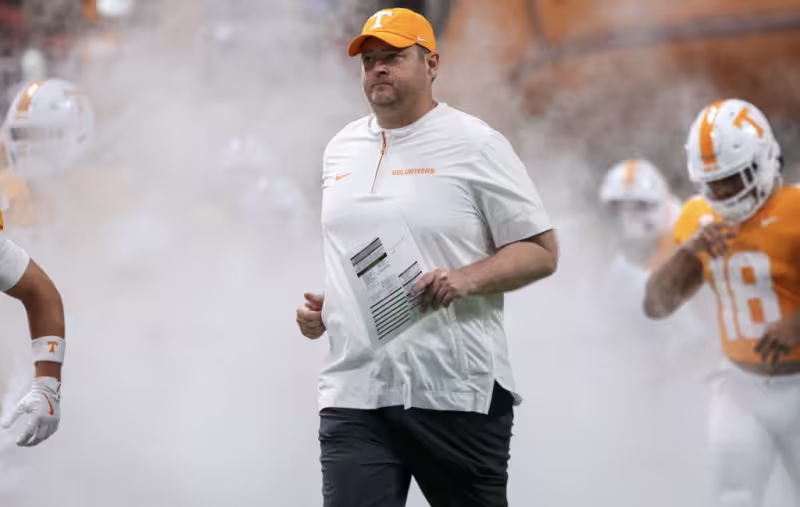
Josh Heupel is confronting a wide-open No. 3 wide receiver competition this offseason after Chris Brazzell moved on to the NFL. The uncertainty at receiver has pushed Tennessee’s tight ends into a spot they did not expect to occupy so quickly.
Braylon Staley and Mike Matthews project as the Vols’ top two wide receivers, leaving the No. 3 job up for grabs between Travis Smith, Radarious Jackson, Joakim Dodson, Tristen Keys and Tyreek King. That scramble matters because Tennessee has, at times over the last two seasons, trotted out three tight ends on the field — a formation that can change both personnel usage and play-calling.
Two of those tight ends are catching attention. Ethan Davis and DaSaahn Brame are both catch-first tight ends who have been improving as blockers, and coaches think their skill sets could be more than complementary. Brent Hubbs put it bluntly about Davis: "Ethan Davis’s athletic ability is very, very obvious, and we all saw that last year." He added a note of caution and praise: "It’s just a matter of Ethan staying healthy. If Ethan can stay healthy, then I think he’s going to be a really good tight end for this group, and a really good player. And behind him, DaSaahn Brame is a freak athlete."
An anonymous Tennessee source told CBS Sports that Davis is a "super athletic tight end that can catch like a wide receiver and play in space," a description that aligns with what Tennessee has tried to build schematically. Heupel has praised Brame’s route work this spring: "He’s very natural as a route runner." Heupel added that Brame "understands space, leverage, and being able to go up and high point with a big catch radius… He has definitely grown in becoming a complete tight end, of being able to play in the run game and protection, too. I am really excited about what he’s done." Heupel also noted Brame’s durability question coming into college: "That’s a guy that missed a bunch of time with an injury coming out of high school."
The comparison coaches and analysts pull out is not about personality but production. Tennessee’s potential use of multiple tight ends is being measured against the 2011 New England Patriots, when Rob Gronkowski and Aaron Hernandez combined for 169 receptions, 2,237 yards and 24 touchdowns. If Tennessee does lean harder on its tight ends in 2026, those numbers are the kind of benchmark that could make defenses adjust and force mismatches in the middle of the field.
Still, the picture is not clean. The Vols’ receiver room remains unsettled at the No. 3 spot, and the tight ends’ rise depends on two fragile variables: health and blocking development. Both Davis and Brame are labeled catch-first, and while coaches report improvement in their blocking, using them as primary weapons will require consistent protection and durability over the course of a season. That tension — elite receiving upside versus the physical grind of college run schemes and pass protection — is the real question Heupel must answer before fall practice begins.
If Davis can stay healthy and Brame continues his rapid development, Tennessee’s tight end group could become a central axis of the Vols’ 2026 passing attack. With the No. 3 wide receiver job unresolved, Heupel’s staff appears willing to gamble on tight ends producing perimeter-like receiving value from the slot and seams, a shift that could reshape Tennessee’s offense this fall.