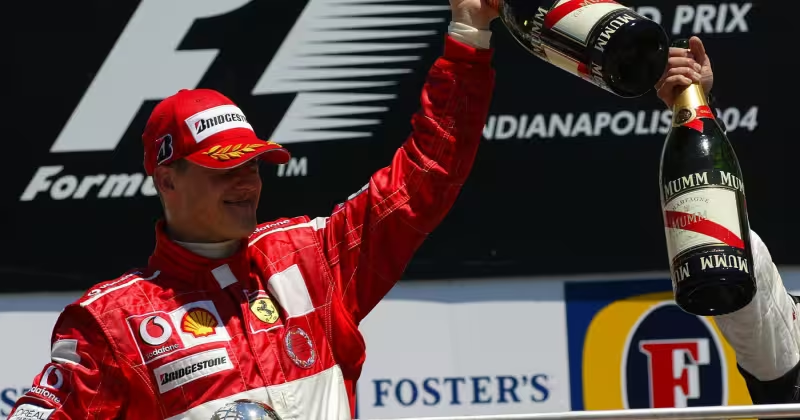
In 2002 Michael Schumacher told CBS News' 60 Minutes that the Indianapolis 500 was “a step down from Formula 1” and “too dangerous,” a judgment that is resurfacing now that his son, Mick Schumacher, will race at the Indianapolis Motor Speedway in 2026.
Schumacher’s comments were blunt. “First of all, it's a step down from Formula 1, and second, it is too dangerous,” he said, adding: “The speed you do that close to the walls, if you have an accident, there is no way a chassis can survive a certain way of having a crash.” He warned of the human cost in equally stark terms: “That means your legs can be heavily damaged or even further,” and concluded, “And I don't see any point in that. I have nothing to prove there.”
The numbers behind the warning mattered then and still do now. In 2002 Schumacher had just secured his then-equalling fifth world drivers' championship. At the Indianapolis Motor Speedway the last recorded fatality had been Scott Brayton, the 1996 pole-sitter who was killed in practice after a crash at Turn 2. A year after Schumacher's remarks, Tony Renna would be killed in a 2003 test at the 2.5-mile oval. For all the danger Schumacher cited, he had repeatedly raced on that same asphalt in Formula 1: between 2000 and 2006 he won five of the seven Formula 1 races staged at Indianapolis Motor Speedway, including the infamous six-car 2005 event.
Context is important: Schumacher never competed in the Indianapolis 500. His critique was aimed at the oval’s close walls, its speeds and its culture of risk — and at what he saw as a gulf between the two worlds. “People who usually cannot survive in Formula 1, they go to Indy,” he said. “People who come from Indy hardly survive in Formula 1.” Those comments, made on national television, helped frame a conversation about whether the two disciplines could be compared or bridged safely.
The tension now is immediate and personal. Mick Schumacher, who qualified 27th for his first Indianapolis 500 with Rahal Lanigan Letterman Racing, is preparing to drive for the team that counts two-time winner Takuma Sato among its roster. The son’s choice to enter Indy’s flagship race collides with the father’s public rejection of the event. Fans and pundits are left to weigh legacy against lived warnings: the same surname evokes championship pedigree and specific public concern about the oval’s hazards.
That contradiction is where the story sharpens. Michael Schumacher dominated at IMS in Formula 1 but refused the Indy 500 itself; he framed the American oval not only as a lesser test but as one that could inflict catastrophic harm to a driver’s limbs and career. Yet the sport’s calendar, the movement of talent and the presence of teams like Rahal Lanigan Letterman Racing mean drivers and families still choose Indianapolis, even when voices as prominent as Schumacher’s counsel otherwise. The split between his wins on the road course and his refusal to race the 500 underscores a larger friction in motorsport: when prestige, money and opportunity meet personal judgment about risk, those forces do not always align.
The most consequential question now is simple and urgent: will Mick Schumacher's entry into the Indy 500 change perceptions shaped by his father’s words, or will those words influence how teams, fans and safety officials view the event going forward? Mick's start in 2026 arrives with history built on both triumph and tragedy — from Brayton’s 1996 death to Renna’s 2003 testing crash — and with a father who publicly dismissed the race on safety and sporting grounds.
Whatever happens on race day, the outcome will do more than write another name into the program. It will test whether a high-profile rejection of the Indianapolis 500, voiced by one of Formula 1’s greatest drivers at the peak of his powers, still carries weight when the son wearing the same name straps into the car and takes the green flag.