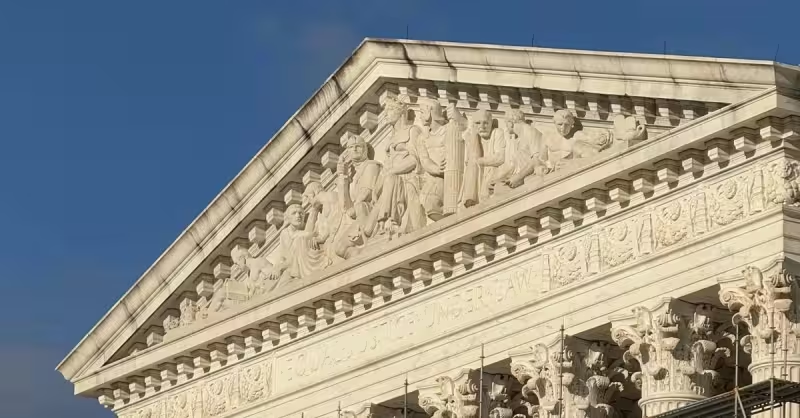
The Supreme Court of the United States will keep rolling out decisions on May 28, with rulings on some of the biggest cases of the term expected by early July. The justices have already heard nearly 60 cases this term, and the final stretch could decide fights over presidential power, birthright citizenship, guns and transgender athletes.
The timing matters because the court often saves major opinions for the last days before its summer recess. This year’s docket still includes Donald Trump’s bid to shield his executive order on birthright citizenship, his clash with independent agencies and legal fights over deportation protections for Syrians and Haitians. One of the most closely watched disputes has already shaken up this year’s elections: the court ruled against Trump’s tariffs in January 2026.
Trump signed the birthright citizenship order on the first day of his second term, directing federal agencies not to recognize the citizenship of babies born in the United States if neither parent is a citizen or lawful permanent resident. The move has been widely viewed as a legal long shot, but the justices could stop it on two different grounds. They could say it violates the 14th Amendment’s citizenship guarantee, or they could strike it more narrowly by finding that it conflicts with a 1952 immigration law.
The court also appeared unlikely to let Trump fire Lisa Cook from the Federal Reserve’s Board of Governors, even as a majority of the justices seemed ready to side with him in a separate case over presidential control of more than a dozen independent agencies. That split captures the shape of this term: the court has not settled on a single line for Trump’s executive power, but it has been willing to test how far that power can reach.
Another major confrontation centers on immigration. Trump argued that the courts have no say in his decision to end deportation protections for Syrians and Haitians, while immigrant rights advocates are challenging the terminations. The administration says the law that created the Temporary Status Protection Program bars judicial review of which migrants may live and work in the United States. The Justice Department has also asked the court to reopen the door to a border practice that would let federal officials stand at the U.S.-Mexico border and block undocumented migrants from physically setting foot on U.S. soil, and to overturn a ruling that requires the government to process claims from people who reach a port of entry.
For people caught inside those cases, the stakes are not abstract. Bethany Hall, who is studying to become a Christian minister, said the court’s 2004 ruling in Locke v. Davey was “quite simply wrong and very sad” and added, “That’s $20,000 that I just lost because I’m studying what I feel like I should do with my life.” Her case shows how a Supreme Court decision can reach far beyond the courtroom and into a student’s future.
There is also a familiar pattern at work. The court does not announce in advance which opinions are coming, but it is more than halfway through the cases it heard this term. With the remaining decisions still to come, the justices will decide not only how much power Trump has in his second term, but also whether the administration can keep pushing the country’s most divisive immigration fights into the summer without a clear judicial check.