Mohamed Esa won the men’s Cape Town Marathon on Sunday in 2:04:55, setting a course record and running the fastest marathon on African soil.
On the women’s side, Dera Dida Yami took the title in 2:23:18. The men’s podium was filled out by Yihunilign Adane in 2:04:59 and Kalipus Lomwai in 2:05:06; Mestawut Fikir was second among the women in 2:23:46 and Waganesh Mekasha third in 2:23:57.
For Esa, the result was more than a victory. "Thanks to the race organisers for giving me the chance to run on my home continent. To break the course record is special for me," he said, later adding, "I am very happy to run in Africa, the course is very nice and the support was very good. Eliud is my role model, I respect him so much. I was proud to race with him in Africa."
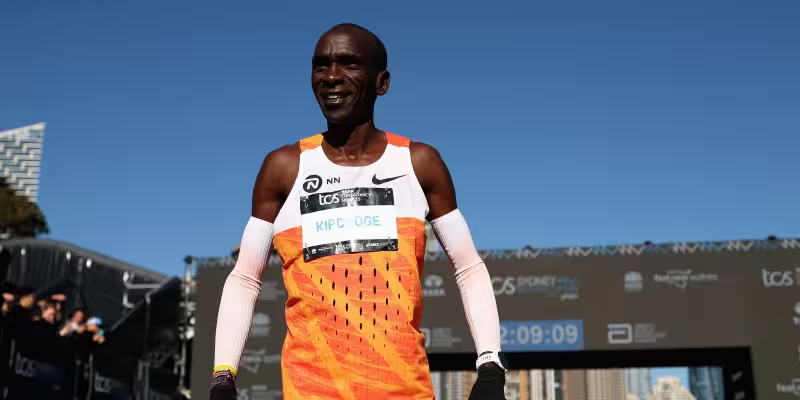
The field also included Eliud Kipchoge, who finished 16th in 2:13:29 on May 24 and was second in the masters division. Kipchoge, who said in March he was preparing the race in part to reach more people, told reporters here that he was focused more on inspiration than on a target time: "I am training normally, preparing my mind like any other race" and "But it is a different race. It’s more for inspiration and to reach more people than in the [past] marathons." He added, "I am not giving a stipulated time that I need to run in Cape Town…"
The numbers underline why this mattered on the day: Esa's 2:04:55 not only reset the course standard but also marked the fastest marathon ever run on African soil, while two established names — Adane and Lomwai — chased him to times of 2:04:59 and 2:05:06 respectively. Kipchoge's 2:13:29 stood out as a slower tune-up compared with his career highs, but his presence widened attention on the race and on the continent.
Organisers said this year’s event was the final assessment toward Cape Town joining the World Marathon Majors in 2027. That race bid arrives after a bruising run of cancellations: the 2025 Cape Town Marathon was cancelled due to high winds, and in 2024 the race was called off 90 minutes before the start for the same reason. The event had previously been moved from October to May 24 ahead of those disruptions.
Context matters: Cape Town is bidding to become the eighth World Marathon Major, and if it meets the necessary criteria it could be added as early as 2027. Kipchoge, who announced plans last year to run a marathon on each of the seven continents and chose Cape Town for the African leg, brings to the city a record that includes 11 World Marathon Majors wins, two Olympic gold medals and two world records — plus an exhibition sub-two-hour run of 1:59:40.
The tension in Cape Town was plain: a breakthrough performance that rewrites records on African soil, and the presence of the sport’s biggest name running more for reach than for time. Esa leaves with the headline result; Kipchoge leaves the course having expanded the race’s profile but not its finishing order at the front.
For Mohamed Esa, the win is both personal and strategic. He set the mark where organisers hope the race will soon sit among the sport’s elite. If Cape Town meets the World Marathon Majors’ criteria, Esa’s 2:04:55 will be written into the record books of a marathon that could join the majors in 2027 — and that, by itself, would change the stakes of winning here.