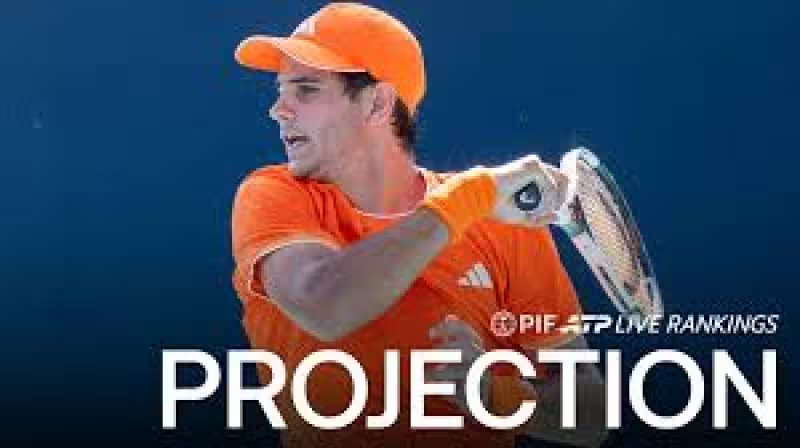
Rafael Jodar will arrive in Paris on Sunday as one of the 32 seeds at the French Open after a year that began with him ranked around No. 700 and finishing his freshman year at the University of Virginia.
Jodar, 19, turned professional after winning several ATP Challenger titles and forgoing his final three years of college eligibility. He also recorded his first main-level ATP match victory at this year’s Australian Open, a breakthrough that helped vault him into seeded status for Roland Garros.
The raw numbers underline how fast this has happened: roughly No. 700 a year ago, and now a seeded player at a Grand Slam before his 20th birthday. That rise is what makes Jodar’s entry into the top tier of the draw newsworthy today — seedings shape opening-week matchups and the expectations that come with them.
Spain’s long pedigree on clay provides the context for why his ascent matters. The country’s modern dominance was built over decades, from Francisco Franco’s order in the early 1970s to create thousands of red clay courts to the men who followed: Sergi Bruguera won back-to-back French Opens in 1993 and 1994; Rafael Nadal accumulated 22 major titles and remains a measuring stick for young Spaniards; Mats Wilander’s 1982 French Open was the first of seven grand slams for him; Björn Borg won 11 majors in an eight-year span beginning in 1974; and Stefan Edberg produced six majors between 1985 and 1992. More recently, Carlos Alcaraz won his first major at the 2022 US Open and has added six more major titles since, though he will miss this year’s French Open and Wimbledon with a wrist injury.
That history is the gravity well Jodar now orbits. The Spanish system that produced so many champions is often traced back to those clay courts and the coaching methods that developed there; observers say those techniques have become standard worldwide. Jodar’s emergence has already redirected attention within Spain’s next generation — João Fonseca, who had been committed to play college tennis at Virginia with Jodar, chose to turn pro as well, and Jodar’s quick rise has shifted focus away from Fonseca.
There is friction beneath the tidy headline of a seeded teenager. Seed status at a major can be both protection and pressure: it shields a player from facing the very highest-ranked opponents immediately, but it also elevates expectations that a 19‑year‑old who left college eligibility on the table may not be ready to meet. Comparisons to Nadal and other Spanish greats are easy to make — Jodar has been likened to a young Nadal and has said Nadal inspired him as a child — yet the history that frames him also raises the bar he must clear on Paris clay.
For fans tracking the draw, Jodar is only one of several storylines beginning Sunday. Elsewhere in the early schedule, James Duckworth’s opener is receiving attention; a separate preview notes Gabriel Diallo is favored in Duckworth’s first match here. Jodar’s seed will shape who he avoids in early rounds, but it will not spare him from the physical and tactical tests unique to Roland Garros.
The single question that now matters is whether Jodar’s rapid climb from college freshman and a ranking near No. 700 to a seeded Grand Slam player will translate into the consistency required to win matches on Paris clay against seasoned opponents. If he is to fulfill the promise that led some to call him a future champion, the French Open will be the first serious test of whether Spain’s latest prospect can convert potential into results.