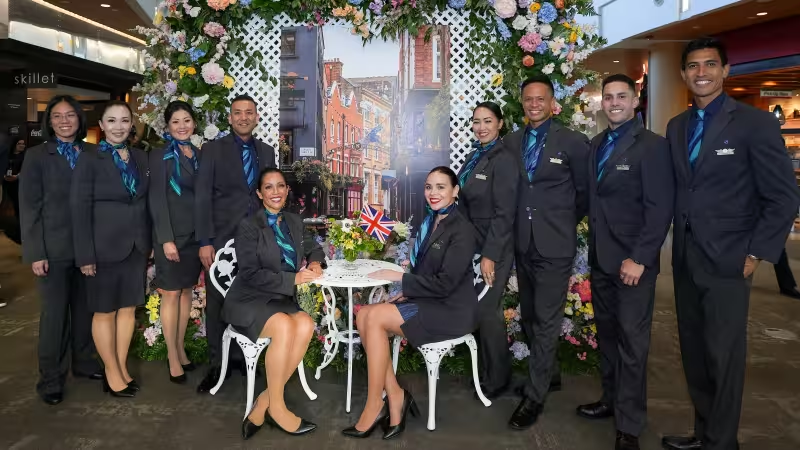
Alaska Airlines began daily nonstop service between Seattle and London Heathrow on Thursday, launching a year‑round route that flies from Terminal 3 with the carrier’s widebody 787-9 aircraft.
The London flights bring Alaska’s second European destination of 2026 after last month’s Rome launch and arrive with a clear product pitch: the 787-9 used on the route features 34 enclosed suites with fully lie‑flat seats in Business Class, aimed at long‑haul travelers between the U.S. West Coast and Britain.
London is the largest intercontinental market from Seattle, with more than 400 passengers traveling between the two cities daily, and Alaska said the new service opens access to Europe for U.S.-based guests while giving UK travelers connections through Seattle to the Pacific Northwest and Alaska Airlines’ West Coast network, including Hawaii.
“As we connect the West Coast to Europe in new ways, our focus is on delivering a meaningful experience that feels distinctly Alaska – warm, thoughtful and elevated at every touchpoint,” said the Chief Commercial Officer, Alaska Airlines. “For our guests in the U.S., we’re opening more convenient access to Europe with the airline they know and love, and for our guests in Europe and beyond, we’re bringing our signature West Coast hospitality to every step of the journey, reflecting the comfort and care we’re known for.”
The route operates daily and year‑round out of Heathrow’s Terminal 3, a strategic slot for transatlantic links. Alaska framed the service as part of a wider push: it plans to begin nonstop service to Reykjavík, Iceland, on May 28, adding another North Atlantic gateway this spring.
London’s airport officials welcomed the new link. “Every new route launched from Heathrow gives passengers and businesses more choice and stronger connections to the world,” the Chief Customer Officer, London Heathrow Airport, said. “Alaska Airlines’ new service to Seattle further strengthens our transatlantic network, opening up opportunities for travel and trade between the UK and the U.S. West Coast.” The same official added, “Working closely with airline partners like Alaska is how we deliver the connectivity passengers and businesses want – and keep the UK competitive globally.”
Alaska has pitched the move as more than a point‑to‑point expansion: the carrier says London connections will feed its broader West Coast system, including onward service to Alaska and Hawaii. The airline’s international buildout this year — Rome, now London, and Reykjavík next month — is the clearest sign yet of that strategy.
The biggest immediate evidence of scale is in the product and frequency: a daily 787‑9 with 34 enclosed Business Class suites signals a long‑haul commitment beyond a seasonal experiment. At the same time, Alaska’s ground infrastructure is still catching up to its ambitions. The airline’s landmark lounge at Seattle‑Tacoma International Airport is scheduled to open in late 2027; Alaska says the two‑level facility will be among the largest in the country and part of a multimillion‑dollar investment across its expanding lounge portfolio designed to support international growth.
That timing creates a tension. Alaska is adding European destinations rapidly, but travelers routed through Seattle on international itineraries will not see the carrier’s promised flagship lounge experience until late 2027, when the two‑level facility opens. For now, the airline must rely on partner lounges and airport facilities while its transatlantic schedule and premium 787‑9 product try to win loyal long‑haul customers.
What matters next is whether Alaska can convert the clear demand between Seattle and London — more than 400 passengers daily before this launch — into sustained transatlantic market share without the immediate boost of its own major airport lounge and while competing with established carriers on frequency and connectivity. The May 28 Reykjavik launch and the results of the London route over the coming months will be the first hard tests of that bet.