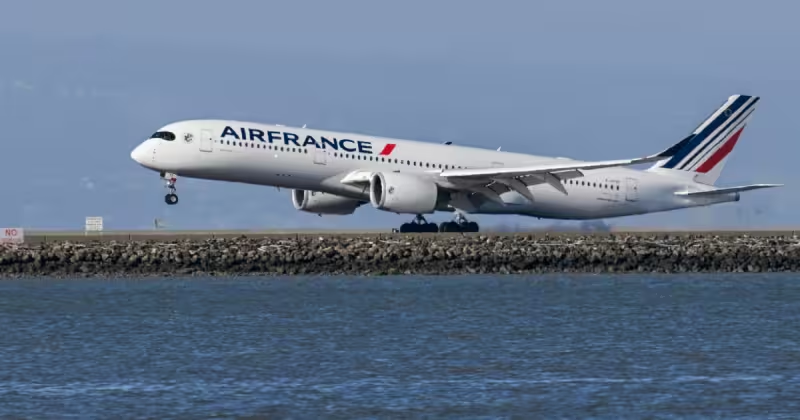
On Wednesday an Air France flight from Paris to Detroit was diverted to Montreal after a passenger from the Democratic Republic of Congo boarded in error, and U.S. officials said the person should not have been allowed on the plane. U.S. Customs and Border Protection said, "Air France boarded a passenger from the Democratic Republic of Congo in error on a flight to the United States."
Passengers said the captain spoke to the cabin after boarding and confusion; one traveller, Deborah Mistor, recounted the announcement and the delay. "I think enough people must have been questioning what was going on because 30 minutes later, [the captain] came back on and said that he wanted to confirm that there was nothing wrong with the plane, there were no technical difficulties, that it was strictly because of US authorities not allowing us to land in the US," she said.
The Air France flight was diverted by about 500 miles and landed at Montreal Airport at the request of U.S. authorities after the Congolese passenger was denied entry to the United States, the airline said. Canadian officials said a Public Health Agency of Canada Quarantine Officer assessed the traveller and determined they were asymptomatic, and the passenger was flown back to France.
The diversion unfolded against an Ebola outbreak in central Africa that has killed about 140 people and produced more than 600 suspected cases, and that the World Health Organization has declared a public health emergency of international concern. On Monday, U.S. public health officials announced new entry controls: the United States is restricting entry for people without U.S. passports who were in the Democratic Republic of Congo, South Sudan or Uganda in the last three weeks. U.S. passport holders and permanent residents who have been in those countries must enter only through Washington-Dulles International Airport for enhanced screening.
Health Canada provided a brief health assessment on Wednesday: "A Public Health Agency of Canada Quarantine Officer assessed the traveller and determined they were asymptomatic," the agency said. Air France summarized the operational action: "at the request of US authorities, [the flight] was diverted to Montreal Airport after a Congolese passenger on board was denied entry into the United States."
The move underscores how new U.S. entry rules are being applied in real time. The CDC-era restrictions are framed around a 21-day or three-week window for possible symptoms after travel to affected countries; the U.S. policy announced Monday is aimed at limiting the cross-border spread of Ebola while allowing targeted screening of travellers deemed at higher risk.
Tension in the episode is plain: the U.S. says the passenger should not have boarded at all, yet the person did. That gap — between a restriction in place and a traveller getting onto an outbound aircraft — prompted the diversion and a transatlantic detour. U.S. Customs and Border Protection's statement that the passenger "boarded in error" is the sharpest line of accountability so far; Air France described complying with U.S. instructions; Canadian quarantine officers found no symptoms and returned the traveller to France.
The diversion also sits beside another worrying fact: one American who worked with a medical missionary group in the Democratic Republic of Congo tested positive for Ebola and was being treated in Germany, a reminder of why authorities tightened borders. For travellers watching travel restrictions to canada and the United States, the Montreal landing offered an immediate example of how screening rules can ripple across flights and airports.
The single most consequential unanswered question raised by the incident is whether airlines and U.S. authorities will change boarding procedures so that the next flight does not require a 500-mile diversion to enforce entry rules already on the books.