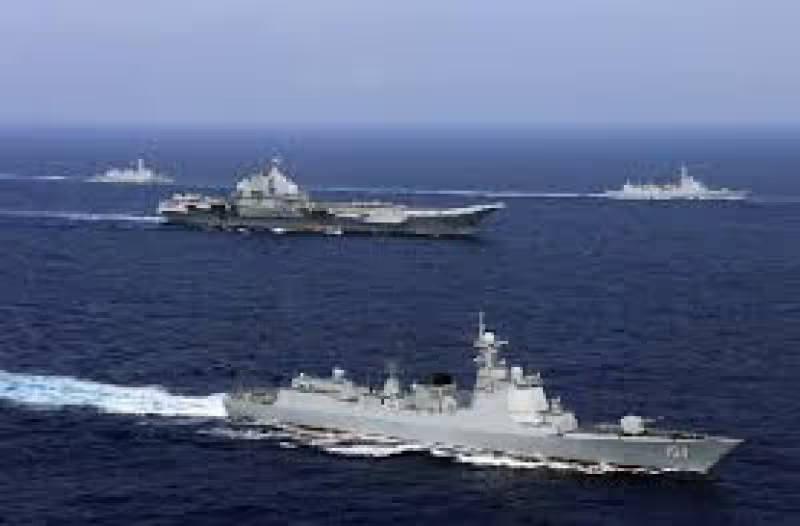
Joseph Wu warned that the People’s Republic of China deployed over 100 vessels around the 1st Island Chain in the week after President Donald Trump’s Beijing summit with Xi Jinping.
Wu, who posted the alert on X a little more than a week after Mr. Trump left Beijing, said Taiwan intelligence had tracked the massing and that it threatened regional calm. "Our ISR/intel shows that the PRC has deployed over 100 vessels around the 1st Island Chain over the past few days, so soon after the Beijing summit," he wrote, and added bluntly: "In this part of the world, China is the one & only PROBLEM wrecking the Status Quo & threatening regional peace & stability." Wu also posted a graphic that appeared to show deployments in the South China Sea, the East China Sea, near Taiwan and close to the Philippines.
The scale matters. Taiwan’s National Security Council echoed Wu’s timeline, saying the deployments came in the week following the Trump-Xi meeting and that more than 100 vessels were active in waters surrounding Taiwan. The number — and the locations shown in the graphic — underline why the island is the focus: Taiwan produces roughly 90% of the world’s advanced semiconductors, a concentration that makes any military pressure there a global economic flashpoint.
Those deployments arrived against the backdrop of a sudden, public pause in U.S. weapons shipments to Taiwan. Acting U.S. Navy Secretary Hung Cao told lawmakers during a Tuesday hearing that Washington was "doing a pause in order to make sure we have the munitions we need for Epic Fury." U.S. lawmakers had approved a $14 billion weapons package for Taiwan in January, but President Trump has not yet signed off on that sale. Taiwanese officials say they were not alerted to any potential pause.
Chinese officials have framed Taiwan as central to their diplomacy with the United States. Chinese Foreign Ministry spokesperson Mao Ning said President Xi "stressed to President Trump that the Taiwan question is the most important issue in China-U.S. relations," a point that, if coupled with visible naval activity, could be read as a diplomatic and military signal rolled into one.
The friction is immediate. On one side sits a Taiwanese government sounding alarm over a concentrated naval presence; on the other, U.S. military leaders publicly acknowledging a temporary hold on deliveries meant to bolster Taipei’s defenses. The pause, according to Hung Cao, is an operational decision tied to the U.S. need to ensure munitions for "Epic Fury." Taiwanese officials say they were not notified, and that gap — between Washington’s public explanation and Taipei’s account of being left in the dark — creates a dangerous ambiguity at a time Chinese vessels are reportedly operating near the island.
The juxtaposition is stark: Beijing, according to Taipei’s intelligence and the National Security Council, appears to be testing or signaling in the water. Washington, even as Congress approved a major arms package in January, is signaling limits on immediate deliveries. And Taipei, reliant on those weapons for deterrence, says it received no warning of the hold. That triangular mismatch — between PLA deployments, a U.S. pause, and Taiwanese surprise — is the precise condition Joseph Wu warned would "wreck" the status quo.
The practical consequence is clear: an unannounced pause in shipments at a moment of reported Chinese concentration of ships will erode deterrence unless coordinative steps follow. The most consequential unanswered question is whether Washington will resume the arms deliveries and notify Taipei, or whether the pause becomes long enough to change calculations in Taipei and Beijing. If shipments remain paused while naval activity continues, the balance that has kept a tense stability around the island could shift in ways that increase risk.
For now, Joseph Wu’s warning stands as both alert and challenge: Taipei has publicly flagged the ship deployments and their timing; Beijing has signaled the centrality of Taiwan in U.S.-China ties; and Washington has said it needs stockpiles for its own operations. How those three threads are untangled will determine whether this episode becomes a short diplomatic scrape or the opening of a more dangerous chapter in the china taiwan standoff.