A new mural honoring Ona Judge Staines will be unveiled this weekend in Portsmouth, New Hampshire, timed to the 230th anniversary of her escape from the president’s house in Philadelphia.
Judge was born into slavery on george washington’s plantation and fled north on May 21, 1796 when she was in her early 20s, escaping the presidency’s household in the city that served as the nation’s temporary capital.
She lived as a fugitive for more than 50 years after her flight, ultimately settling in Portsmouth, where she married and had three children while evading capture. The mural project in Portsmouth had been in preparation for three years and its image of Judge is an artistic interpretation — there are no known photos or illustrations that document her appearance.
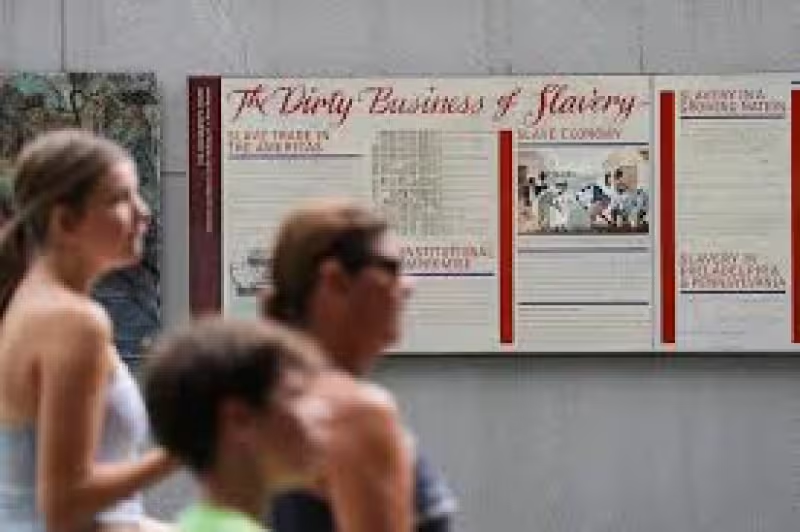
The unveiling follows a summer of renewed attention to how the nation remembers enslaved people connected to the first president. This year the National Park Service removed explanatory panels from an exhibit at Philadelphia’s Independence National Historical Park that had mentioned Judge by name along with eight others whom the Washingtons enslaved; the exhibit was restored in February under a court order.
Community leaders in Portsmouth say the episode in Philadelphia helped spur interest in marking Judge’s life on the street. "When you try to take something away, in the way that was done, then people want to know what it’s all about," JerriAnne Boggis said, adding more broadly that "it made us really aware just how important it is to have these visible signs of Black history, permanent visible signs in our landscape."
Erica Armstrong Dunbar, who has written about Washington’s enslaved people and is slated to speak at a reception in Portsmouth after the mural’s unveiling on Saturday, called the removal episode "maddening" and defended the historical work that had been displayed in Philadelphia as accurate.
"It exists on the street where passersby can examine it. They don’t have to have tuition in a college classroom or purchase a book. This is history available to all," Dunbar said of public visual history projects, and she added, "And it’s clear that this administration is uncomfortable with that." She also noted the power of visual art to reach people: "By using the visual arts, it also engages people who are creative-leaning, it engages people who like good stories, and it engages people who want to know about their past in order to inform their present and perhaps the future."
The mural’s advocates say putting Judge on a wall in Portsmouth addresses a gap left by decades of official memory that often omitted the lives of those enslaved by prominent founders. The Philadelphia panels had named Judge and eight others; their removal became a flashpoint that drew public attention back to individual stories like Judge’s.
For Portsmouth, the mural is both memorial and public classroom. Organizers hope the work will prompt people who walk by to stop and ask who Ona Judge Staines was and why her life matters now — not as a footnote to a famous household, but as a person who chose freedom and built a family while under the shadow of capture.
There is friction between that local effort and the federal exhibit controversy: the Park Service’s removal of panels suggested a willingness to limit visible references to enslaved people in high-profile federal sites, even as historians and activists pushed for fuller public accounts. The court-ordered restoration in February underscored how contested these decisions remain.
Saturday’s unveiling will pair the mural’s public reveal with a reception where Dunbar will speak, and where residents will be invited to connect the image on the wall with the documented facts of Judge’s life: her escape on May 21, 1796; her life in Portsmouth as a wife and mother of three while living as a fugitive for more than half a century.
The mural does not attempt photographic fidelity; artists acknowledge it is an interpretation. That choice is explicit and, in the view of supporters, deliberate: with no known portraits to reproduce, the work aims to restore presence rather than prove likeness. For a woman born into slavery on George Washington’s plantation who spent decades outside public memory, permanence on a Portsmouth wall is the point.
Put plainly: the mural makes her visible. It insists that Ona Judge Staines — the woman who fled the president’s house in Philadelphia in 1796 and lived the rest of her life in New Hampshire — belongs in the landscape, not only in footnotes or contested museum panels.