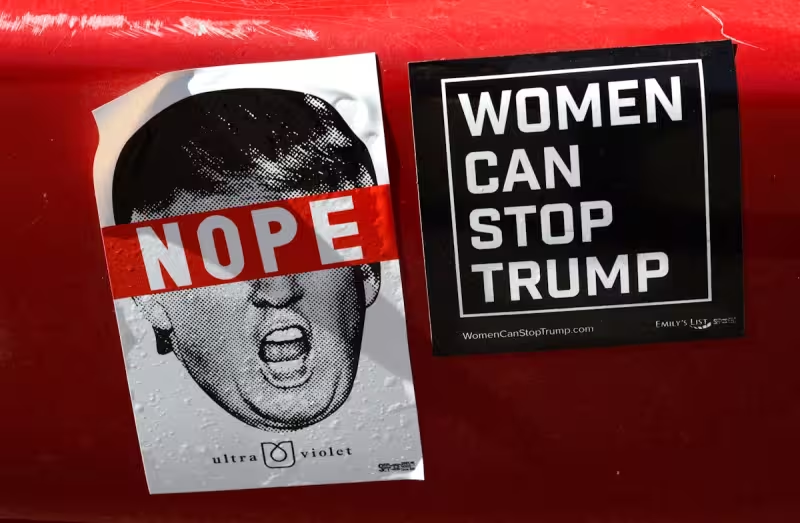
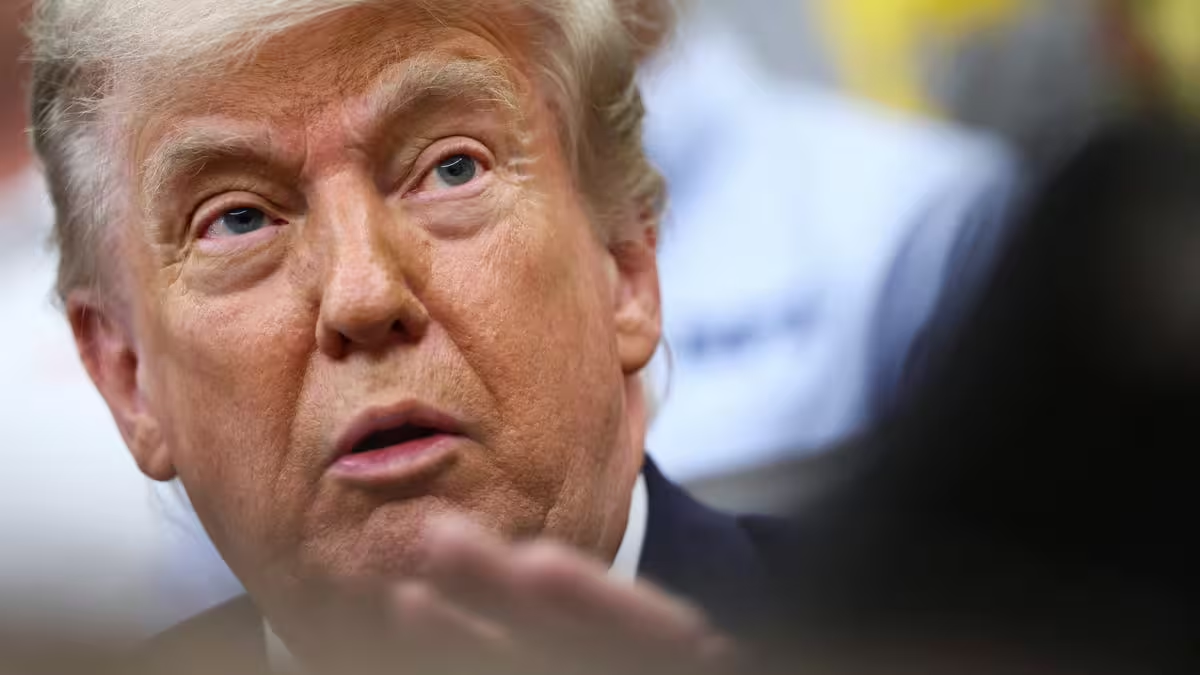
A YouGov poll released this week found more Democratic women than Republican men said they could win a physical fight with Donald Trump, the 79‑year‑old at the center of a national discussion about his fitness and his grip on reality.
The number that gives the poll weight isn't tiny: another YouGov survey showed 22 percent of men thought they could beat a chimpanzee in a fight, and the reporting points out that 25 percent of Republican men "cannot all be wheelchair-bound invalids in hospice," a wry comparison offered to measure what it would take to lose a scuffle with the former president. Trump himself has long cast himself as "very tough," a line his allies repeat even as the physical signs accumulate.
Those signs are plain in the details now under discussion: Trump struggles to walk in a straight line and to climb stairs; he has massive edema around his ankles and is said to live on Big Macs and Diet Coke; he believes exercise is bad for you. He also brags about passing the Montreal Cognitive Assessment, a test generally given to people suspected of having dementia that includes identifying pictures of a lion, a camel and a giraffe.
Context matters here. The poll is being read not as an isolated oddity about bravado but as another data point in the argument that many Republicans have adopted Trump’s version of events. He encouraged a shared unreality long before his first term — most notably as a prominent birther who insisted Barack Obama had been born in Kenya — and at the start of his presidency Sean Spicer was sent out to tell the world Trump had set an attendance record at his inauguration. Supporters were instructed, in one memorable formulation attributed to Trump, to "reject the evidence of your eyes and ears. It was his final, most essential command." That pattern — insistence on a preferred narrative despite obvious counter-evidence — is the bridge between the poll and why it matters.
The tension is sharp. Trump's public persona is built on toughness and dominance; he repeats it, he is quoted saying he is "very tough," and he flaunts a cognitive test passed as proof. Yet the physical descriptions — difficulty walking a straight line, trouble with stairs, swollen ankles — and the dietary and lifestyle details undercut that image in a way that ordinary voters understand without medical nuance. The poll's odd comparisons — to men versus chimps, to hospice‑bound invalids — expose a gap between the boast and the body. At the same time, large swaths of his party have shown a willingness to ignore contradictions that once would have derailed a candidate.
The clash has consequences for 2024. If voters weigh physical fitness and coherence the way this poll suggests, those voters — and not pundits or press releases — will decide whether Trump's toughness claims hold up at the ballot box. Culture and commerce will keep the story in feeds alongside less grave headlines; gaming outlets are already reporting Wolverine Marvel to Kick Off PlayStation State of Play on June 2 and local pages are filled with community events like Kicks off in Topeka: Futamura USA marks 10 years with carnival, fireworks
The single, consequential question now is whether Republican voters will continue to accept Trump's constructed reality — to embrace the line that leads with toughness and asks followers to "reject the evidence of your eyes and ears" — or whether the mounting, plain‑spoken physical observations and the quirky poll results will force a reassessment before the 2024 election.