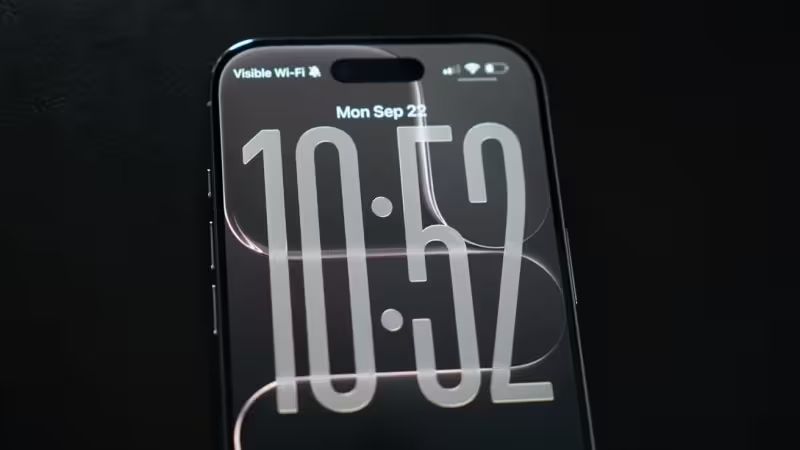
Digital Chat Station says Apple is testing a prototype iPhone—identified as a 2027-generation Pro device—that bends its display around all four edges, and the leaker added: "Apple has already entered mass production testing of the device."
The prototype reportedly carries a hole-punch cutout for the front-facing camera while Face ID is tucked entirely under the panel, a combination that underlines how far Apple has pushed screen engineering and how far it still has to go.
Those details matter because multiple reports frame the 2027 handset as Apple’s 20th‑anniversary iPhone and a potential renaming moment: the company may call the 2027 model iPhone 20 Pro to mark 20 years of the iPhone. Industry trackers call the rumored quad-curved display "the biggest design change in a decade," and the shift from a flat or mildly curved edge to a display wrapping all four sides would be the most visible redesign since the iPhone X in 2017.
Technical breadcrumbs line up. Digital Chat Station described a "quad-curved OLED display" and said the device is at the evaluation stage; the same leaker also flagged mass production testing. Ice Universe, another industry account, warned that Apple’s approach to the edges is not a dramatic waterfall bend but an "extremely subtle" four-edge curvature. And reports going back to September 2025 say Samsung Display was already working on the Color Filter on Encapsulation technology that the Liquid Glass Display will use—an advance cited as necessary for these micro-curved OLED panels.



AppleInsider reported on May 21, 2026, that the 2027 model was undergoing evaluation and mass production testing, a sequence that leakers now echo. The timeline matters: Apple is expected to announce the iPhone 18 Pro in fall 2026, with the iPhone 19 Pro—or the possibly renamed iPhone 20 Pro—targeted for fall 2027. Digital Chat Station has a record of early hits, having correctly shared details on prior models, which gives weight to its current claims about the quad-curved prototype and production status.
And yet the story is less clean than the display brag suggests. The prototype’s hole-punch cutout, the confirmation that Face ID sits under the panel and the repeated caveat from sources reveal a stubborn engineering problem: Apple is finding it particularly challenging to hide both the Face ID system and the front-facing camera under the display. Leakers say the selfie camera is the most difficult element to conceal, and they add a practical limit: if Apple cannot hide the camera under the panel without degrading image quality, it is unlikely to use that under‑panel camera solution.
That contradiction is the newsroom’s tension. On paper, a seamless quad-curved screen with no visible cutouts would be a headline-making anniversary move. In practice, mass production testing and the presence of a hole-punch on current prototypes suggest Apple is prepared to trade perfection for performance: ship the four-edge display now and only remove visible camera hardware if under-panel image quality meets Apple’s standards.
Given the evidence, the most likely outcome is pragmatic. Apple appears to have the display technology close to production—partners and prior reports point to Samsung Display’s panel work and to manufacturing trials—but the company will not sacrifice camera quality for a cleaner front face. Expect a fall 2027 launch that showcases a subtle, quad-curved OLED screen and hidden Face ID; whether the phone debuts completely cutout-free will come down to whether Apple’s under-panel camera meets its image-quality bar during the remaining tests. If it does not, the first quad-curved iPhone may ship with a small hole-punch or a visible compromise rather than the uninterrupted front glass many expect.