Deadline reported that AI-enhanced versions of six public figures — including Mark Zuckerberg — will appear in Doug Liman’s AI-enabled satire Bitcoin, and that Zuckerberg has the most lines among them.
Liman, who directed the film, told reporters the production used a "markerless performative capture stage" and that the AI work is central to how the movie was made. He framed the new pipeline as an economic and creative shift, saying "the film can be made at — a still hefty — $70M rather than $200M or $300M."
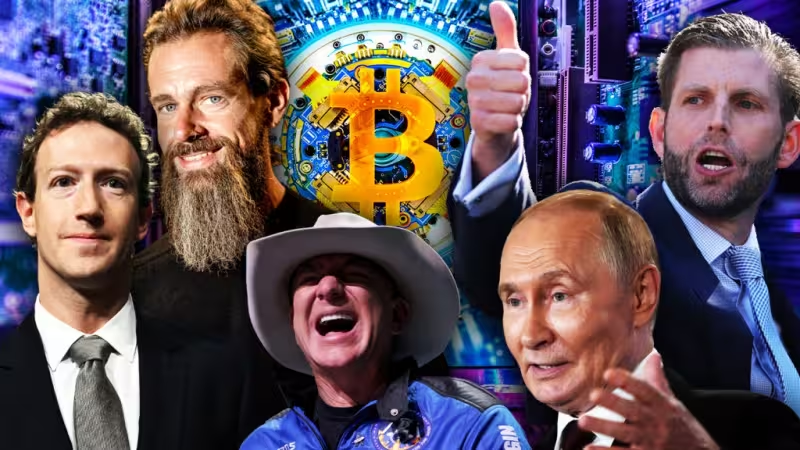
The list of six figures includes Jeff Bezos, Jack Dorsey, Vladimir Putin, Kim Jong Un and Eric Trump in addition to Zuckerberg, and producers expect a fleeting nod to Elon Musk. The movie stars Casey Affleck, Pete Davidson, Gal Gadot and Isla Fisher, with Affleck playing computer scientist Craig Wright, Davidson as blockchain investor Calvin Ayre and Gadot as Charlotte Miller. Nick Schenk wrote the film, Ryan Kavanaugh and Lawrence Grey produced it, and Patrick Wachsberger's 193 was selling Bitcoin at the Cannes market.
On the story side, Bitcoin follows a man's quest to prove he created bitcoin. That man is based on Australian computer scientist Craig Wright, who has publicly claimed to be part of bitcoin's creation but was ruled by the British High Court in 2024 not to be Satoshi Nakamoto and ordered to stop saying he is.
What will raise eyebrows is how the public figures appear on screen. Performances of Bezos, Zuckerberg and the others were initially recorded by actors on camera, the filmmakers say, but those performances will likely go through AI enhancement so they better resemble the real people. Approvals from the actors to undergo AI changes were already agreed, according to earlier casting notices, and the filmmakers are using Ryan Kavanaugh's proprietary AI within his ACME AI label along with Liman's PECAN process. The production was shot in only 20 days and is now in post-production.
The project has provoked a string of mismatched messages. An April set visit reported by The Wrap said "no AI would be used on any actual actors," a line that conflicts with current reporting that AI-enhanced likenesses will appear and that on-camera performances will be altered. Deadline, which first ran the list of figures, summed up the moment bluntly: "Hold onto your crypto. This could get interesting."
Filmmakers insist the movie aligns with the AI guidelines of the Hollywood guilds, but the public contrast between The Wrap's on-set description and the later disclosures underscores a practical tension: the tools are in play, the rules are being cited, and the boundaries between actor, likeness and AI enhancement remain unsettled. Liman's claim that the tech shrinks a traditional high-end budget of hundreds of millions to $70M also flips the usual argument that realistic AI work is prohibitively expensive.
For Mark Zuckerberg, who is reported to have the most lines among the featured public figures, that means his presence will be both prominent and digitally processed. Whether audiences will see a performance that reads as an actor's interpretation or as a synthetic doubling of a real person is the immediate consequence. The film will be watched closely at the Cannes market and in guild circles as an early, high-profile test of putting recognizable living figures through AI enhancement.
The clear conclusion is this: Bitcoin will not be a quiet experiment. With Zuckerberg on screen more than any other public figure in the film, and with the production and sales machinery already moving at Cannes, the movie will serve as a practical test of how much Hollywood can reshape on-camera performances with proprietary AI while still claiming adherence to guild guidance.