Washington, D.C. took the top spot in the 2026 ParkScore Index, holding on to its status as the nation’s best big-city park system as other major cities shuffled behind it. The ranking from Trust for Public Land measures park systems in the 100 largest American cities, weighing accessibility, equity, acreage, investment and amenities.
For people who use parks every day, the result is more than a title. In Houston, where officials and advocates have been trying to narrow long-running gaps, the city ranked No. 69 this year, down from No. 66 last year. Houston still dedicated about 12.2 percent of its land to parks, above the national average of 9.3 percent, but 65 percent of residents live within a 10-minute walk of a park, below the national average of 76 percent. City spending on park maintenance also trails the typical large city, at about $137 per resident versus $154 nationally.
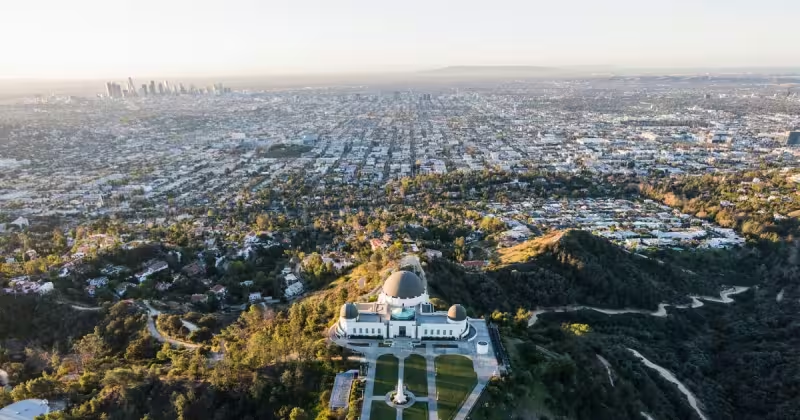
After Washington, D.C., the top five nationally went to Irvine, California at No. 2, Minneapolis at No. 3, St. Paul at No. 4 and Cincinnati at No. 5. Los Angeles landed at No. 93, slipping three spots from 2025, while Santa Clarita moved up to No. 42 from No. 63 a year earlier and Long Beach rose to No. 54, two places higher than last year.
That broader spread matters because the index is not just rewarding total acreage. It also captures whether parks are close enough to use, whether they are spread fairly across neighborhoods and whether cities are putting money into them. Molly Morgan, speaking about Texas cities, said they are “making serious investments, opening new parks, partnering with school districts, and closing gaps that have existed for decades,” and added that they are “showing what’s possible when Texas gets serious about parks.” She also pointed to the “9 million Texans who don't have a park within a 10-minute walk of their homes.”
Toledo offered a different kind of progress story. Its parks system ranked No. 59, up from 77th place in 2020, and Metroparks Toledo said it had reached its goal of placing a Metropark within five miles of every home in Lucas County. Scott Carpenter said, “Since 2020, we’ve moved up from 77th place,” and noted that “There are five criteria and one is for park space equity,” adding that “We have a higher score for equity in our community than even the top five of the communities on that list.”
For Washington, D.C., the headline is simple: it remains the benchmark. For cities trying to catch up, the gap is no longer about whether parks matter, but whether local leaders are willing to pay for them, place them where people live and make them usable enough to keep climbing.